You’ve just been handed a 12-page service agreement. Your new client wants it signed by Friday. You open it, scan the first paragraph and immediately feel that familiar combination of confusion, anxiety, and the uncomfortable suspicion that something buried in page seven might be really important.
So you do what millions of small business owners, freelancers, and entrepreneurs do: you skim it, hope for the best, and sign. Or you spend $400 on a one-hour attorney consult for a $3,000 project that barely justifies the fee.
Neither option is good. And neither is necessary, because understanding legal documents without a lawyer is a learnable skill. Not a law degree. A skill. One thing this guide will give you by the time you finish reading it.
You can understand legal documents without a lawyer by learning the five key clauses every contract contains, decoding common legal terms in plain language, and using guided contract tools that explain each section as you go. For standard business agreements, service contracts, NDAs, and contractor agreements, legal literacy is within reach of any business owner. Snaplegal makes this process even simpler with attorney-drafted, plain-language templates.
In this guide, you’ll get a complete framework for reading, understanding, and creating legal documents with confidence, no law degree, no expensive consultants, and no more signing things you don’t fully understand.
Why Legal Documents Feel Impossible to Read (It’s Not Your Fault)
Legal language, formally known as “legalese”, wasn’t designed for clarity. It evolved over centuries of court decisions, each adding layers of specialized terminology to prevent loopholes and withstand judicial scrutiny. The result is documents that are technically precise but practically impenetrable for anyone without legal training.
Here’s the uncomfortable truth that most legal professionals don’t advertise: the complexity of most standard business contracts is not proportional to their actual content. A well-drafted service agreement covers about six core concepts. A typical 15-page contract covers the same six concepts, interspersed with redundant phrasing, subordinate clauses, and archaic 1890s terminology that has never been updated.
According to a study published by the American Bar Association, more than 80% of Americans struggle to understand standard legal documents, including many of the ones they sign regularly. This isn’t a literacy problem. It’s a design problem. And the solution isn’t to become a lawyer. It’s to learn what to look for.
The 5 Sections That Matter Most in Any Business Contract
Every business contract, regardless of length or complexity, is built around five core components. Once you understand these, you can read any standard agreement with confidence.
1. Scope of Work (or Scope of Services)
What it is: The precise description of what one party agrees to deliver to the other.
Why it matters: This is the #1 source of business disputes. Vague scope language is an open invitation for disagreement. When you read this section, ask: Could a third party who wasn’t part of the original conversation read this and know exactly what’s included and what isn’t?
Red flag: Phrases like “and other related services,” “as needed,” or “to the client’s satisfaction” without objective criteria.
2. Payment Terms
What it is: How much is owed, when it’s due, by what method, and what happens if it’s late.
Why it matters: This section directly controls your cash flow and your legal recourse if payment is withheld. Missing payment terms are why so many small business invoices go unpaid without consequence.
Red flag: No specified due date (“payment due upon completion”), no late fee provision, or no milestone structure for larger projects.
3. Intellectual Property Ownership
What it is: Who owns the work product designs, code, content, and strategies once they’re created and delivered.
Why it matters: Without a clear IP clause, ownership is legally ambiguous. In the U.S., work created by an independent contractor typically belongs to the creator unless the contract explicitly assigns it to the client. Many businesses sign contracts that inadvertently give away IP they intended to keep.
Red flag: Broad “work for hire” language that assigns all rights to the client before full payment is received.
4. Termination Clause
What it is: The conditions under which either party can end the agreement, how much notice is required, and what compensation is owed for work already completed.
Why it matters: Without this clause, either party can argue they’re still bound by the agreement indefinitely or that they can exit with no obligation. This clause also determines whether you get paid for work in progress if a project is cancelled.
Red flag: A termination clause that allows the client to exit “for convenience” with no payment obligation for work already performed.
5. Dispute Resolution
What it is: The agreed process for resolving disagreements is typically a sequence of negotiation, mediation, arbitration, and, as a last resort, litigation.
Why it matters: Without this clause, any dispute goes straight to court, the most expensive, slowest, and most emotionally draining option. A well-drafted dispute resolution clause keeps disagreements out of the courtroom in the vast majority of cases.
Red flag: No dispute resolution clause at all, or a clause that grants one party sole discretion to determine the outcome.
Plain-Language Legal Glossary: 20 Terms You’ll Actually Encounter
This is a plain-language explanation of the legal terms that appear most frequently in small-business contracts, decoded.
| Legal Term | What It Actually Means |
|---|---|
| Indemnification | One party agrees to pay for damages or legal costs if their actions cause a problem for the other party. Think of it as a liability transfer clause. |
| Limitation of Liability | A cap on how much one party can owe the other if something goes wrong. Typically expressed as a dollar amount or percentage of the contract value. |
| Force Majeure | Protects both parties from consequences of extraordinary events beyond their control, natural disasters, pandemics, wars. Neither party is in breach if these events prevent performance. |
| Representations and Warranties | Statements of fact that each party is making about themselves and their ability to fulfill the contract. If these turn out to be false, it can be grounds for breach or rescission. |
| Governing Law | Which state’s legal system will apply to interpret and enforce the contract if a dispute arises. Critical for cross-state business relationships. |
| Confidentiality / Non-Disclosure | Both or one party agrees not to share certain information with outsiders. The NDA you sign before a business pitch is a standalone version of this clause. |
| Assignment | Whether either party can transfer their rights or obligations under the contract to a third party (e.g., if a company is sold or merges). |
| Severability | If one clause in the contract is found to be unenforceable, the rest of the contract remains valid. This prevents one bad clause from voiding the entire agreement. |
| Entire Agreement / Integration Clause | This written contract is the complete and final agreement, any prior verbal discussions or promises are not legally binding. Everything must be in the document. |
| Liquidated Damages | A pre-agreed amount one party pays if they breach the contract. Avoids the need to prove actual damages in court, the penalty is already defined. |
| Notice | The required process for formally communicating important information under the contract (like termination or breach). Often specifies method (written, email) and timing (30 days). |
| Breach | Failure to fulfill a contractual obligation. Can be material (major, justifying contract termination) or minor (smaller violation with limited consequences). |
| Consideration | Something of value exchanged by each party that makes the contract legally binding. Usually money in exchange for services or goods. |
| Counterparts | Both parties can sign separate physical or digital copies of the same contract, and together those copies constitute one complete, binding agreement. |
| Waiver | One party voluntarily gives up a right under the contract. Importantly, waiving a right once doesn’t necessarily mean you’ve waived it forever, check the specific language. |
| Non-Compete | Restricts one party from working with competitors or starting a competing business for a specified time and geographic area after the contract ends. |
| Non-Solicitation | Prevents one party from poaching the other’s clients or employees during or after the contract period. |
| Escrow | Funds or assets held by a neutral third party until specific contract conditions are met. Common in real estate, M&A, and high-value service agreements. |
| Arbitration | A private dispute resolution process where a neutral third party (arbitrator) hears both sides and issues a binding decision, usually faster and cheaper than litigation. |
| Material Adverse Change (MAC) | A significant negative event that allows one party to exit the agreement, commonly found in investment and acquisition contracts. |
How to Read a Legal Contract Without Confusion: Step by Step
Reading a contract strategically rather than linearly from page one to the end makes the process far faster and more effective. Here’s the framework:
- Start with the definitions section.
- Most contracts define key terms upfront. Read this first. When you encounter a capitalized term like “Deliverables,” “Services,” or “Confidential Information” throughout the document, it has a specific meaning defined in this section, not the everyday meaning.
- Read the scope of work in full.
- This is the heart of the contract. Read every word. Ask yourself: Is everything I’m expected to deliver listed here? Is there anything listed that wasn’t part of my understanding? Is the language vague enough to be interpreted multiple ways?
- Jump to payment terms and do the math.
- Calculate the total potential payment, including all conditions. Map out the payment schedule on a calendar. Identify the late fee structure. Confirm the payment method is one you accept.
- Read the termination clause.
- Who can terminate? Under what conditions? How much notice? What do you receive for work completed if terminated early? This clause determines your financial protection if the relationship ends badly.
- Find and read the IP clause.
- Who owns the work once it’s created? When does ownership transfer upon delivery or upon full payment? Can you use the work in your portfolio? These answers have long-term implications.
- Read the indemnification and limitation of liability clauses carefully.
- These determine your maximum financial exposure. A one-sided indemnification clause can make you responsible for losses far exceeding the contract value. Know your ceiling.
- Check the governing law and dispute resolution clauses.
- If a dispute arises, which state’s courts apply? Is arbitration required? Who selects the arbitrator? Who pays arbitration costs? These terms determine your practical ability to enforce the contract.
- Review any attached exhibits or schedules.
- Many contracts attach additional documents, including a detailed scope, pricing schedules, and technical specifications. These attachments are legally part of the contract. Read them with the same attention as the main body.
9 Contract Red Flags That Should Make You Stop Before Signing
These are the warning signs that experienced contract reviewers look for, and that non-lawyers most often miss:
- 🚩 “Services as requested” or any scope language that’s defined by one party’s future discretion rather than objective criteria written in the contract.
- 🚩 Payment terms that say “net 90” or longer, meaning you won’t be paid for three months after delivering work.
- 🚩 A unilateral right to modify the contract, one party can change terms without the other’s consent. This is rarely acceptable.
- 🚩 Unlimited indemnification with no liability cap, you could be responsible for losses that dwarf the contract value.
- 🚩 Automatic renewal clauses are buried in the contract body, especially with notice periods shorter than 30 days.
- 🚩 Broad non-compete clauses that prevent you from working in your industry for an unreasonably long period or geographic area.
- 🚩 “Work for hire” language that assigns all IP to the client, including pre-existing tools, frameworks, or code you bring to the project.
- 🚩 A dispute resolution clause specifying a city or state that’s far from you, making litigation practically impossible even if you’re legally in the right.
- 🚩 Missing signatures or undated agreements, a contract without proper execution is difficult or impossible to enforce.
Real Example: How One Freelancer Lost $6,000 by Misreading One Clause
The situation: Jordan, a freelance web developer in Denver, CO, signed a client contract without carefully reading the intellectual property clause. The clause included standard “work for hire” language, which Jordan assumed meant the client owned the final website. Reasonable assumption.
What Jordan missed: the clause also assigned ownership of the development framework and component library Jordan had built over three years and used across dozens of client projects. The client later discovered this framework in Jordan’s other projects and sent a cease-and-desist letter claiming ownership.
The cost: Jordan spent $6,000 in attorney fees negotiating a licensing arrangement to regain use of tools Jordan had created years before ever meeting this client. The original contract value was $8,500.
The fix: A single sentence would have prevented this entirely: “For the avoidance of doubt, pre-existing tools, frameworks, code libraries, and intellectual property owned by the Contractor before this Agreement remain the exclusive property of the Contractor.”
Snaplegal’s guided contract creation tool includes this language automatically in contractor agreements, along with plain-language explanations of what each clause means before you finalize it.
Key lesson: You don’t need to be a lawyer to catch this kind of clause. You need a systematic reading process and a tool that flags the critical sections for you.
How to Create Legal Documents for Non-Lawyers Using Snaplegal
Understanding the contracts you receive is one skill. Creating legal documents for non-lawyers that actually protect you is another, and it’s where most small business owners struggle the most.
The traditional options are: hire a lawyer ($200–$500/hour), use a generic online template (risky, may be outdated or inapplicable to your state), or write it yourself (rarely advisable).
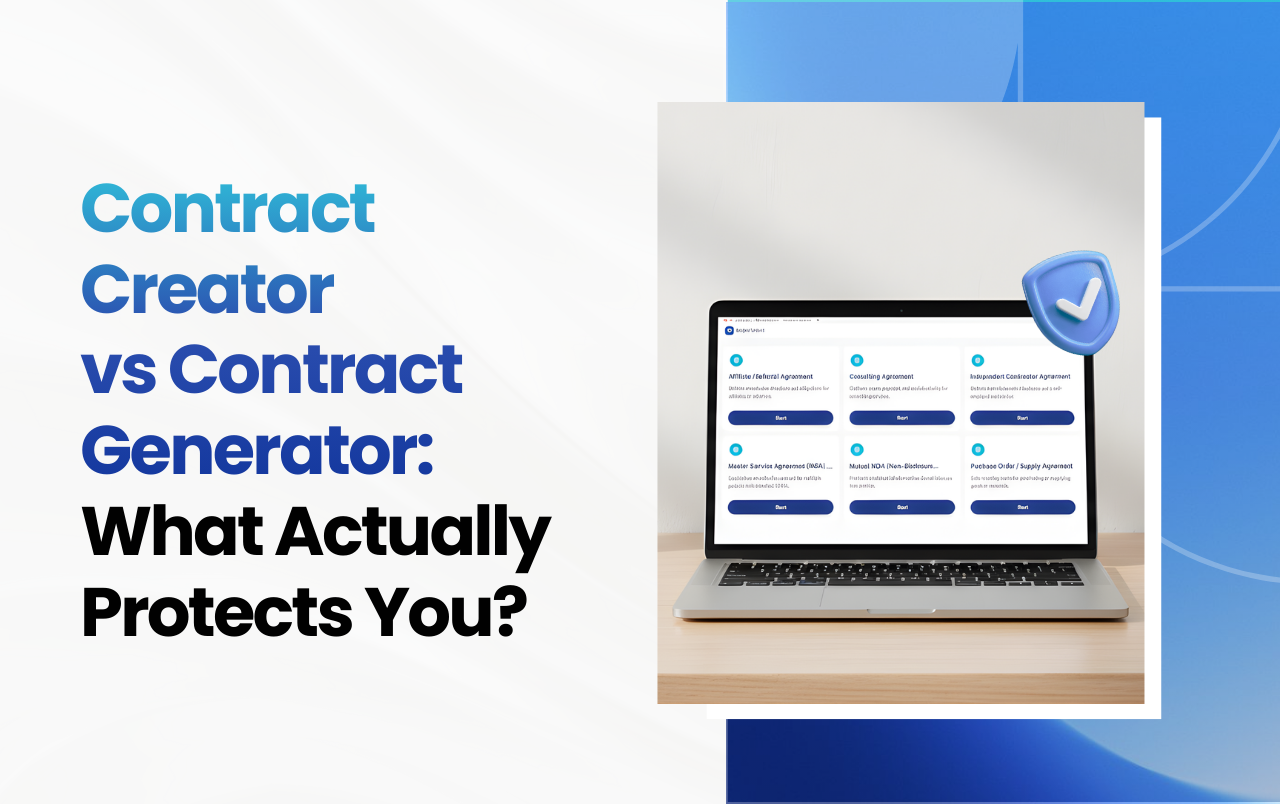
Snaplegal offers a fourth option: a guided, attorney-drafted contract creation workflow that walks you through every section, explains what each clause does in plain English, and lets you customize everything to your specific business without needing any legal expertise.
How It Works
- Select your contract type: service agreement, NDA, contractor agreement, partnership agreement, or one of dozens of other options.
- Answer the guided questions; the tool asks you about your specific situation, and it automatically fills in the relevant fields.
- Review each section of your contract with plain-language explanations, including a plain-English summary of what it means and why it matters.
- Customize critical clauses, adjust scope, payment terms, revision policies, and any deal-specific provisions with built-in guidance at each step.
- Send for a legally valid e-signature compliant with the U.S. ESIGN Act; your signed contract carries the same legal weight as a wet signature.
- Store in your secure contract library, searchable, organized, and accessible whenever you need to reference the agreement.
The entire process from blank to signed contract takes under 10 minutes for standard agreements. And every template is drafted and regularly reviewed by attorneys, so you’re not starting from a risky DIY foundation.
When You Actually Do Need a Lawyer (Honest Answer)
Legal empowerment doesn’t mean legal recklessness. There are situations where attorney involvement isn’t optional, and knowing the line matters as much as knowing what you can handle independently.
You should involve a lawyer when:
- The contract value exceeds $100,000; the stakes justify the cost.
- The agreement involves equity, ownership stakes, or significant IP; the long-term implications are too complex for templates.
- The deal is cross-border, and different jurisdictions create layers of complexity that templates can’t fully address.
- You’re entering a franchise agreement, licensing deal, or acquisition; these are highly specialized and highly consequential.
- The other party’s contract contains unusual, heavily one-sided, or complex clauses that you don’t understand after reading it carefully.
- You’re facing an active dispute or potential litigation; you need representation, not templates.
For everything else, the day-to-day service agreements, NDAs, contractor agreements, and vendor contracts that govern most small business operations, attorney-drafted templates from Snaplegal provide the legal protection you need at a fraction of the cost.
Expert Tips for Becoming Contract-Literate
These are the habits that separate business owners who get burned by contracts from those who consistently protect themselves:
- 📖 Read every contract you sign, every single one. This sounds obvious. Most people don’t do it. Even a 10-minute read of a short contract catches the issues that later cost thousands.
- 🖊️ Never sign under time pressure. “I need this back in an hour” is a pressure tactic, not a legal requirement. You have the right to take a reasonable time to review any agreement. If a party refuses to give you time to read a contract, that refusal itself is a red flag.
- 📝 Annotate as you read. Write questions in the margin (or comments in a digital document). “What happens if this isn’t met?” “Who decides what ‘satisfactory’ means?” These questions, asked before signing, prevent disputes afterward.
- 🔍 Use a plain language contract summary for complex documents. Before finalizing any significant agreement, summarize each section in your own words. If you can’t explain what a clause means in plain English, you don’t understand it yet.
- ⚖️ Negotiate the clauses that don’t work for you. A contract is a starting point for negotiation, not a take-it-or-leave-it document. Is the scope language too vague? Request specificity. Payment terms too long? Propose a shorter cycle. Most reasonable business partners will negotiate standard terms.
- 🗂️ Build a personal legal vocabulary. The 20 terms in this guide cover 80% of what you’ll encounter in standard business contracts. Review them before any major contract signing. Over time, contract literacy becomes second nature.
Frequently Asked Questions
Can I really understand legal documents without a lawyer?
Yes. Most standard business legal documents, such as service contracts, NDAs, contractor agreements, and partnership agreements, can be read, understood, and created by non-lawyers once you know the key sections and common terminology. Tools like Snaplegal simplify the process further with plain-language guidance and attorney-drafted templates that explain each clause as you go.
What are the most important sections to read in any business contract?
The five sections you must always read carefully are: Scope of Work (what’s being delivered), Payment Terms (amounts, dates, late fees), Intellectual Property Ownership (who owns the work product), Termination (how either party exits), and Dispute Resolution (what happens if something goes wrong). These five sections cover the vast majority of business disputes.
What does “indemnification” mean in plain language?
Indemnification means one party agrees to cover the other’s financial losses, legal costs, or damages if something goes wrong due to their actions. In plain terms: if you cause a problem for your client, you pay for it. If they cause a problem for you, they pay. Always check whether this obligation is mutual or one-sided, and whether there’s a liability cap.
What is a plain language contract summary, and why does it matter?
A plain language contract summary translates legal jargon into everyday English, explaining what each clause actually means for you in practice. It matters because most contract disputes don’t stem from bad intentions but from one or both parties not fully understanding what they agreed to. Snaplegal builds plain-language explanations directly into its contract creation process.
When do I actually need to hire a lawyer to review a contract?
Involve a lawyer when: the contract value exceeds $100,000; the deal involves equity, ownership, or high-value IP; you’re operating across jurisdictions or internationally; you’re entering a franchise, licensing, or acquisition agreement; or you’re facing an active dispute. For standard small business contracts, attorney-drafted templates provide sufficient protection for the vast majority of situations.
How can I create a legal document without a lawyer?
Use Snaplegal’s guided contract creation tool: select the appropriate template, answer guided questions, review plain-language explanations at each step, customize key clauses, and send for a legally valid e-signature. The entire process takes under 10 minutes and requires zero legal background. All templates are drafted and reviewed by attorneys.
Conclusion: The Ability to Understand Legal Documents Without a Lawyer Is Now Within Your Reach
Legal literacy used to be a privilege reserved for those who could afford it. That’s no longer the case. With the right framework, vocabulary, and tools, any business owner can confidently and independently read, understand, create, and negotiate the contracts that govern their business relationships.
The key is not to become a lawyer. It’s to know what matters, where to look for it, and when the plain-language version of a clause should raise a question before you sign. That’s the skill this guide has given you the foundation for.
And when it comes to creating contracts that are already written in clear, understandable language with attorney-backed language protecting you at every clause, Snaplegal is built exactly for that. No legal background required. No expensive hourly rates. Just clear, enforceable agreements that both parties actually understand.
→ Start Understanding Legal Documents With Snaplegal’s Guided Tool: plain language, attorney quality.
→ Create Your First Legal Document Without a Lawyer. Ready to sign in in under 10 minutes.