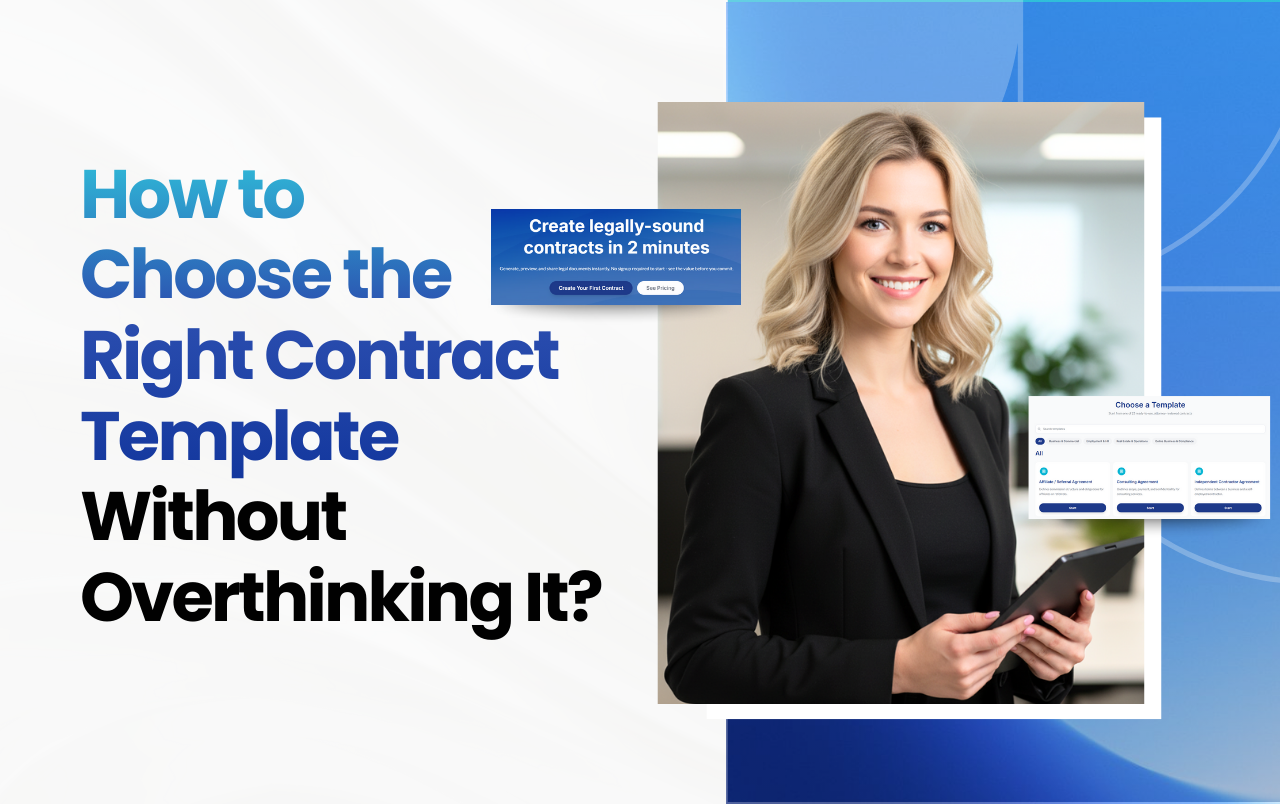
Choosing a contract template sounds simple until you actually try to do it.
You search online and suddenly there are hundreds of options. Free templates. Paid templates. Short ones. Long ones. Some written in plain language, others packed with legal terms you have never seen before.
At that point, many people freeze. Or worse, they pick one at random and hope for the best.
Choosing the right contract template does not have to be complicated. You just need a clear way to think about it.
Start With the Relationship, Not the Document
The biggest mistake people make is choosing a template based on how it looks instead of what it is for.
Before you look at any template, ask yourself one simple question.
What is the relationship this contract needs to define?
Are you hiring someone
Are you being hired
Are you providing services
Are you partnering with another business
The purpose of the agreement matters more than the title of the document. A consulting agreement and a service agreement may sound similar, but they are not always interchangeable.
When you focus on the relationship first, the right category becomes easier to identify.
Do Not Choose Based on Length
Many people assume longer contracts are better and shorter contracts are risky.
That is not true.
A long contract filled with irrelevant clauses can be more dangerous than a shorter one that clearly matches your situation. Length does not equal protection. Relevance does.
A good template includes what you need and nothing you do not.
If a contract is ten pages long but only two pages actually apply to your work, you are creating confusion instead of clarity.
Make Sure the Template Matches How You Work
This is where most templates fail.
They describe an ideal scenario that does not match reality.
For example:
- Fixed project language for ongoing work
- Hourly payment terms for flat-fee services
- Rigid timelines for flexible deliverables
If the template does not reflect how the work will actually happen, it is the wrong template.
A contract should document reality, not force you into it.
Watch for Red Flags in Templates
Some templates come with warning signs you should not ignore.
Overly broad language that benefits only one side
Clauses you cannot understand at all
Missing sections on payment or termination
Language that does not apply to your role or location
If you cannot explain a clause in simple terms, that is a problem. You should never feel pressured to sign or send a contract you do not understand.
Templates are meant to help you, not intimidate you.
Why Guided Templates Work Better
This is where modern contract platforms change the experience.
Instead of making you choose blindly, guided templates adapt based on your answers. You are not guessing which clauses apply. The system helps decide.
Platforms like SnapLegal use guided questions and plain-English summaries to help users select and customize the right agreement without legal guesswork.
This approach reduces mistakes and builds confidence.
You are not just filling in blanks. You are making informed choices.
Understand the Core Sections That Matter
No matter the contract type, certain sections always deserve your attention.
Scope of work
Payment terms
Ownership or rights
Termination terms
Dispute handling
If a template glosses over any of these, it is incomplete.
You do not need every possible clause, but you do need clarity on the basics. These sections define how problems are handled if they arise.
And problems always arise eventually.
One Template Is Not Enough Forever
As your work evolves, your contracts should too.
The template you used when you started freelancing may not work once you take on larger clients. The agreement you used for one-off projects may not fit ongoing relationships.
Revisiting your templates is not a failure. It is a sign of growth.
Contracts are living tools. They should evolve as your business does.
Do Not Overthink Legal Language
You do not need to understand every legal term to choose a good template.
What you do need is:
- Clear explanations
- Logical structure
- Alignment with your real-world situation
Plain-English summaries help bridge the gap between legal language and understanding. They give you confidence without requiring legal training.
If a template makes you feel unsure, it is probably not the right one.
Confidence Is the Best Indicator
Here is a simple test.
After reading your contract template, do you feel confident explaining it to the other party?
If the answer is no, pause.
Contracts work best when both sides understand them. If you are confused, the other party likely will be too.
Choosing the right template should leave you feeling clear, not anxious.
Need Help Choosing the Right Contract Template?
You do not have to figure this out alone.
If you are unsure which contract template fits your situation or want help creating agreements that actually match how you work, it is better to ask than guess.
The SnapLegal team can help you choose and customize the right contract without overthinking it.
Reach out here: https://snaplegal.ai/contactus