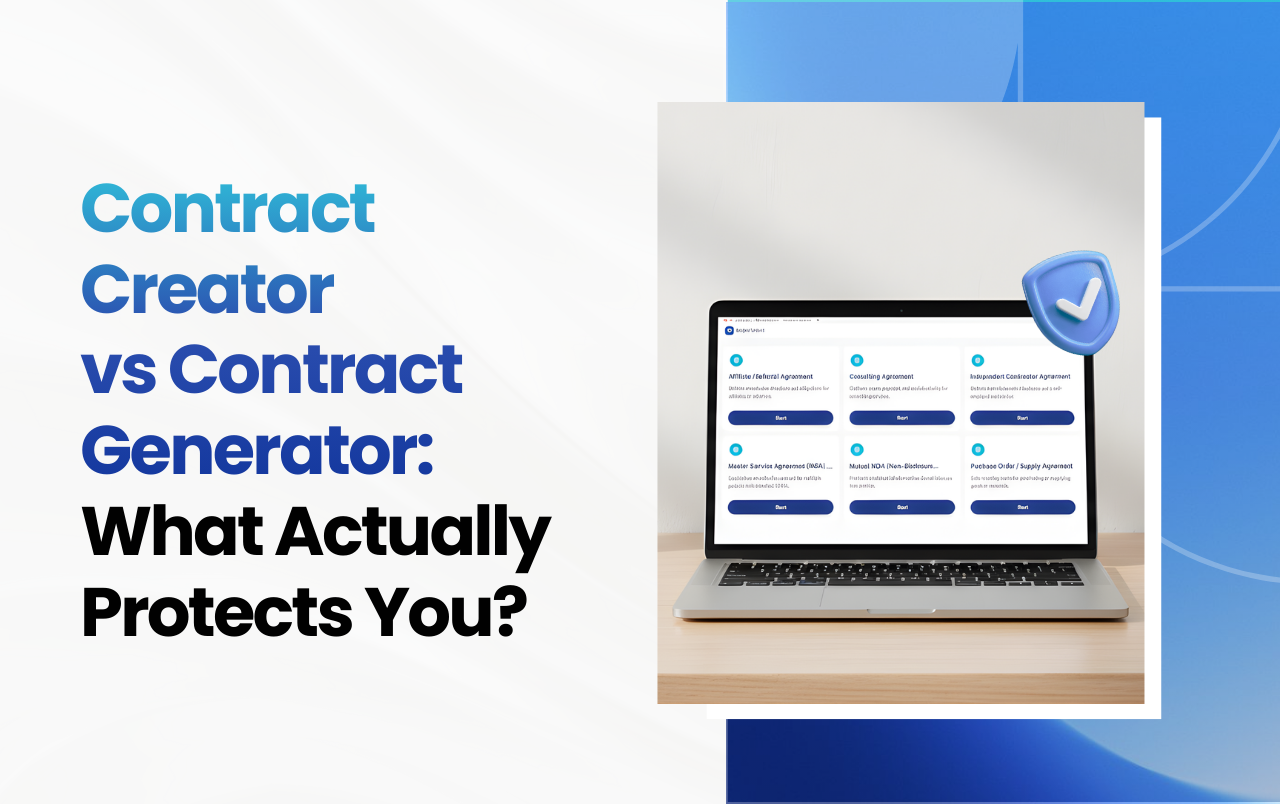
Not all contract tools are doing the same job, even if they sound like they are.
If you’ve searched for a contract generator, you’ve probably seen dozens of tools promising “instant legal documents.” Some of them are helpful. Some of them are… questionable. And almost all of them assume you already know what you’re doing.
That’s where the confusion starts.
A contract generator and a contract creator are not the same thing. One fills in blanks. The other helps you think through the agreement itself. That difference matters more than most people realize.
Let’s break it down in plain English.
What a Contract Generator Actually Does
A traditional contract generator is essentially a smart form.
You choose a document type.
You type names, dates and numbers.
It inserts those details into a prewritten template.
You download the file.
That’s it.
If you already understand contract law, this might be fine. But if you’re a freelancer, founder, or small business owner without legal training, it leaves a lot of gaps.
Contract generators usually:
- Don’t explain clauses
- Don’t adapt language to your situation
- Don’t flag risky choices
- Don’t help you understand what you’re agreeing to
They assume you know what “indemnification,” “governing law,” or “termination for convenience” actually mean.
Most people don’t. And that’s not a failure. It’s just reality.
What a Contract Creator Does Differently
A contract creator takes a more guided approach.
Instead of showing you a full legal document upfront, it walks you through the logic behind the contract. You answer questions in plain language and the system builds the legal terms based on your answers.
A good contract creator:
- Explains what each section does
- Uses simple prompts instead of legal jargon
- Adjusts language based on your responses
- Shows you what you’re agreeing to in clear terms
This is where AI-powered platforms like SnapLegal stand out.
They don’t just generate documents. They help you understand them before you sign.
Why This Difference Matters in the Real World
Let’s say you’re a freelancer creating a client agreement.
A generator might ask:
“Enter termination clause.”
A creator asks:
“What happens if either of you wants to end the project early?”
That small difference changes everything.
One assumes legal knowledge.
The other assumes you’re human.
When contracts are built this way, people make better decisions. They don’t accidentally agree to unlimited revisions, unpaid scope creep, or unclear payment terms.
The Biggest Risk with Basic Contract Generators
The biggest risk isn’t that the contract is invalid. It’s that it’s misunderstood.
Most contract disputes don’t happen because someone wanted to break the rules. They happen because the rules weren’t clear.
If you don’t fully understand:
- When you get paid
- Who owns the work
- How disagreements are handled
- What happens if something goes wrong
You’re relying on assumptions. Assumptions are dangerous in business.
A contract creator reduces that risk by making the agreement understandable from the start.
Plain-English Summaries Are a Game Changer
One feature that separates contract creators from generators is the plain-English summary.
Instead of forcing you to interpret legal language, the platform explains each section in everyday terms. You see:
- The legal text
- The real-world meaning
Side by side.
This isn’t just convenient. It builds confidence.
You stop wondering, “Is this normal?” or “Did I miss something?” You know exactly what the contract does and doesn’t do.
That peace of mind is hard to put a price on.
Speed Without Sacrificing Safety
People often think they have to choose between speed and safety.
They don’t.
A modern AI contract generator that functions as a creator lets you move quickly without cutting corners. You can create agreements in minutes instead of hours, while still knowing what’s inside them.
This matters when:
- Onboarding new clients
- Hiring contractors
- Sending agreements under time pressure
- Scaling operations
The faster you can create clear contracts, the smoother everything else becomes.
Digital Signing: Another Hidden Difference
Many basic generators stop at the document download.
A full contract creator includes:
- Secure digital signing
- Signature tracking
- Tamper protection
- Centralized storage
This means no more emailing PDFs back and forth or wondering if someone signed the latest version.
When contracts live in one secure place, they’re easier to manage, reference and enforce.
Which One Is Right for You?
A contract generator might be enough if:
- You fully understand contract language
- Your agreements are extremely simple
- You’re comfortable reviewing legal terms
A contract creator is better if:
- You want clarity, not just paperwork
- You don’t want to guess what clauses mean
- You value speed and confidence
- You want fewer misunderstandings
Most freelancers, entrepreneurs and small teams fall into the second group.
The Bottom Line
Contracts shouldn’t feel intimidating or confusing. They’re meant to protect both sides and set clear expectations.
If a tool just spits out a document and leaves you guessing, it’s not really helping. A true contract creator guides you, explains things clearly and helps you sign with confidence.
If you’re unsure which approach fits your situation or want help choosing the right contract, don’t guess.
Reach out to the SnapLegal team here: https://snaplegal.ai/contactus