What Is a Contract Drafting Tool?
A contract drafting tool is software that helps you create agreements by guiding structure, clauses, and formatting.
It usually:
- Organizes sections
- Generates content from inputs
- Produces ready-to-use documents
These tools are part of a growing ecosystem that includes:
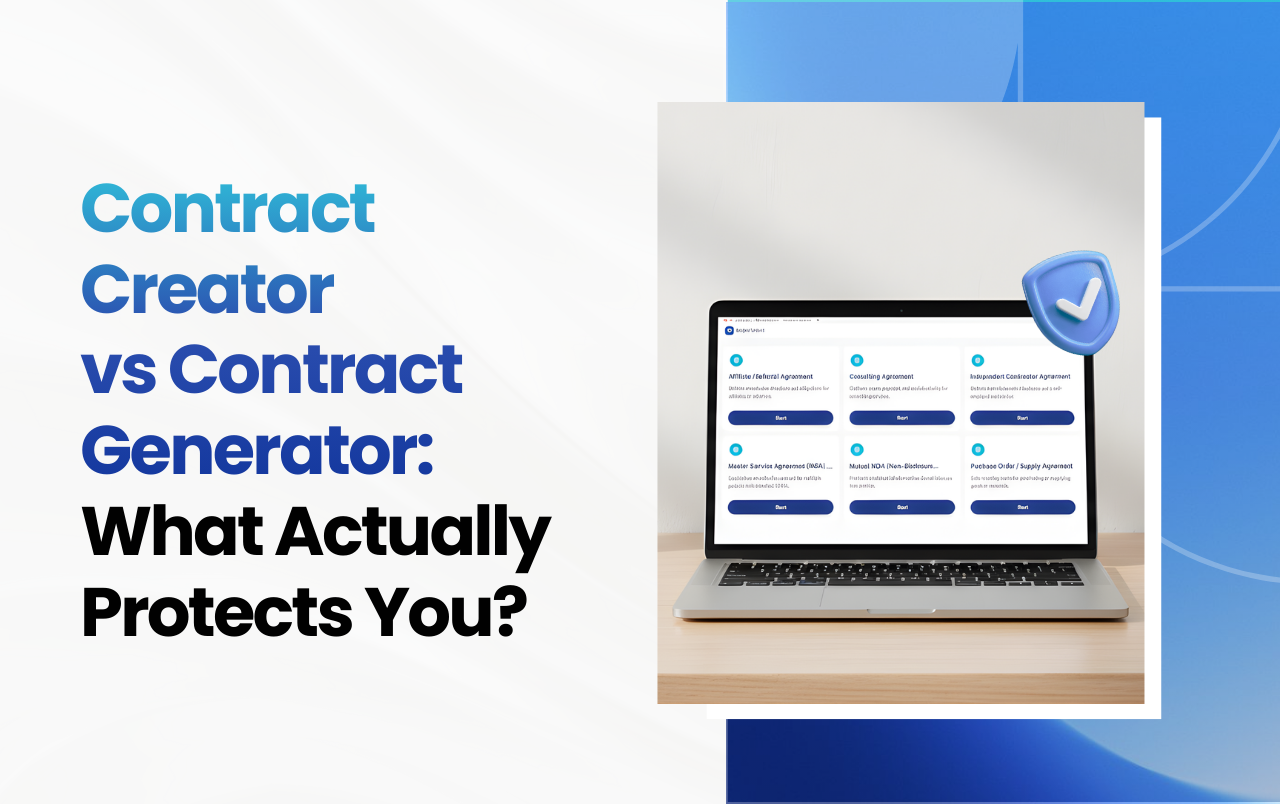
- Contract generators
- Online legal documents platforms
- AI-powered drafting systems
They are built for speed and efficiency.
However, the wrong tool can create problems instead of solving them.
How Can the Wrong Contract Drafting Tool Expose Your Business?
Short answer:
By creating unclear or incomplete agreements.
A weak drafting tool may:
- Skip important questions
- Allow vague inputs
- Generate generic clauses
The result is a document that looks complete but does not clearly define expectations.
This creates risk when:
- Work doesn’t go as planned
- Responsibilities are questioned
- Payments or timelines are disputed
The issue isn’t visible at first. It appears when clarity is needed most.
What Makes a Contract Generator Risky?
It prioritizes speed over understanding.
A contract generator is useful for:
- Quick document creation
- Standard structure
- Repetitive agreements
But it becomes risky when it:
- Doesn’t explain clauses
- Accepts unclear inputs
- Encourages fast completion without review
Automation repeats what you provide.
It does not refine unclear thinking.
Why Do Legal Contracts Online Fail With the Wrong Tool?
However, they rely on generic templates.
Legal contracts online often come from:
- Pre-built templates
- Automated systems
- Quick-generation platforms
If the drafting tool uses:
- Broad wording
- Flexible clauses
- Generic structures
The final document may not match your business reality.
That mismatch becomes visible when expectations differ.
Are Legal Document Templates Enough for Businesses?
No, they need customization and context.
Legal document templates provide:
- A starting point
- Standard sections
- Consistent structure
But templates often include:
- General language
- Assumptions about use cases
Without proper adjustments, they can:
- Miss important details
- Create ambiguity
- Lead to misunderstandings
Templates support drafting.
They don’t complete it.
How Do Digital Contract Platforms Contribute to the Problem?
They organize documents but don’t improve them.
A digital contract platform helps with:
- Storage
- Version control
- Workflow management
These features improve efficiency.
However, they do not:
- Fix unclear clauses
- Add missing details
- Improve document clarity
If a weak document enters the system, the platform spreads that weakness.
Can an AI Legal Assistant Make Things Worse?
Yes, if used without review.
An AI legal assistant can:
- Generate clauses quickly
- Suggest structured wording
- Speed up drafting
But AI relies on:
- Patterns
- Common scenarios
- User inputs
If your input lacks detail, AI fills gaps with general language.
That language may sound precise but may not reflect your actual agreement.
At SnapLegal, we often see users trust AI-generated content without verifying whether it matches their real workflow.
What Are the Warning Signs of the Wrong Drafting Tool?
Look for lack of guidance.
Common warning signs include:
- Minimal explanation of clauses
- No prompts for clarification
- Heavy reliance on default text
- Ability to skip important sections
- Focus on speed over understanding
If a tool feels too easy, it may be skipping important steps.
How Can You Choose the Right Contract Drafting Tool?
Look for clarity, not just speed.
Use this checklist:
1. Does it explain sections?
You should understand what each clause does.
2. Does it guide your inputs?
The tool should help you provide specific details.
3. Does it reduce vague language?
It should encourage clear, precise terms.
4. Does it show how your answers affect the document?
You should see the structure forming.
5. Is it simple but structured?
Ease of use should not remove clarity.
The right tool improves both speed and understanding.
How Does SnapLegal Solve These Problems?
By combining guidance with simplicity.
SnapLegal is a guided, self-serve document creation platform built to help users create clear agreements without confusion.
Instead of relying only on templates or automation, SnapLegal:
- Explains each section in plain English
- Shows how inputs shape the document
- Encourages thoughtful, specific responses
This approach reduces ambiguity before the document is finalized.
You create professional legal documents in minutes while staying in control.
No legal jargon.
No appointments.
No sign-up required to start.
Why Clarity Matters More Than Tool Features
Clarity matters more than the tool features because unclear documents create real-world problems.
A tool may offer:
- Automation
- Storage
- Integration
However, if the document itself is unclear, those features don’t help.Clarity ensures that documents work when needed.
Should You Stop Using Drafting Tools?
No. You should use the right one.
Drafting tools are valuable for:
- Efficiency
- Consistency
- Speed
They become risky when:
- They skip guidance
- They encourage blind automation
- They prioritize output over understanding
Used correctly, they support your business. Used incorrectly, they expose it.
Key Takeaways
- The wrong drafting tool creates unclear agreements
- Generators improve speed but not understanding
- Templates require customization
- Digital platforms organize but don’t fix content
- AI tools rely on clear input
- Guidance reduces risk
Final Summary: The Tool You Choose Shapes the Outcome
A contract drafting tool is more than a convenience.
It shapes how your agreements are created.
The wrong tool speeds up mistakes.
The right tool improves clarity.
SnapLegal helps you create professional legal documents in minutes through guided, self-serve creation designed for freelancers, contractors, and individuals.
No legal jargon.
No appointments.
No sign-up required.
See the value first. Commit later.
Start with SnapLegal today.
Frequently Asked Questions
What is the biggest risk of using the wrong contract drafting tool?
Creating unclear documents that don’t reflect real business expectations.
Are contract generators reliable?
They are useful for structure but require careful input and review.
Do digital contract platforms prevent errors?
They improve organization but do not automatically fix unclear wording.
Can AI legal assistants replace careful drafting?
No. They support drafting but still require oversight.
Do I need to sign up to try SnapLegal?
No. You can start creating documents instantly.