What Is a Contract Generator?
A contract generator is a digital tool that creates agreements automatically based on the information you provide.
It usually works like this:
- You select a template
- Fill in basic details
- Download the completed document
It feels efficient. And often, it is.
However the real issue isn’t speed.
It’s what gets skipped along the way.
Related: Contract Generator Errors That Stop Your Business from Scaling
What Is the Real Problem With a Basic Contract Generator?
It assumes you already know what you’re doing.
A basic generator:
- Does not explain key clauses
- Does not question vague inputs
- Does not guide deeper decisions
It produces documents quickly.
It does not ensure they reflect your real-world situation.
That gap creates silent risk.
Why Do People Trust Basic Generators So Easily?
People are quick to trust basic generators because the output looks professional.
Most generated documents:
- Use formal language
- Follow familiar contract structure
- Appear complete
That appearance builds confidence.
Nonetheless, professional formatting does not equal precision.
At SnapLegal, we often see users surprised by how much they assume a template is handled automatically.
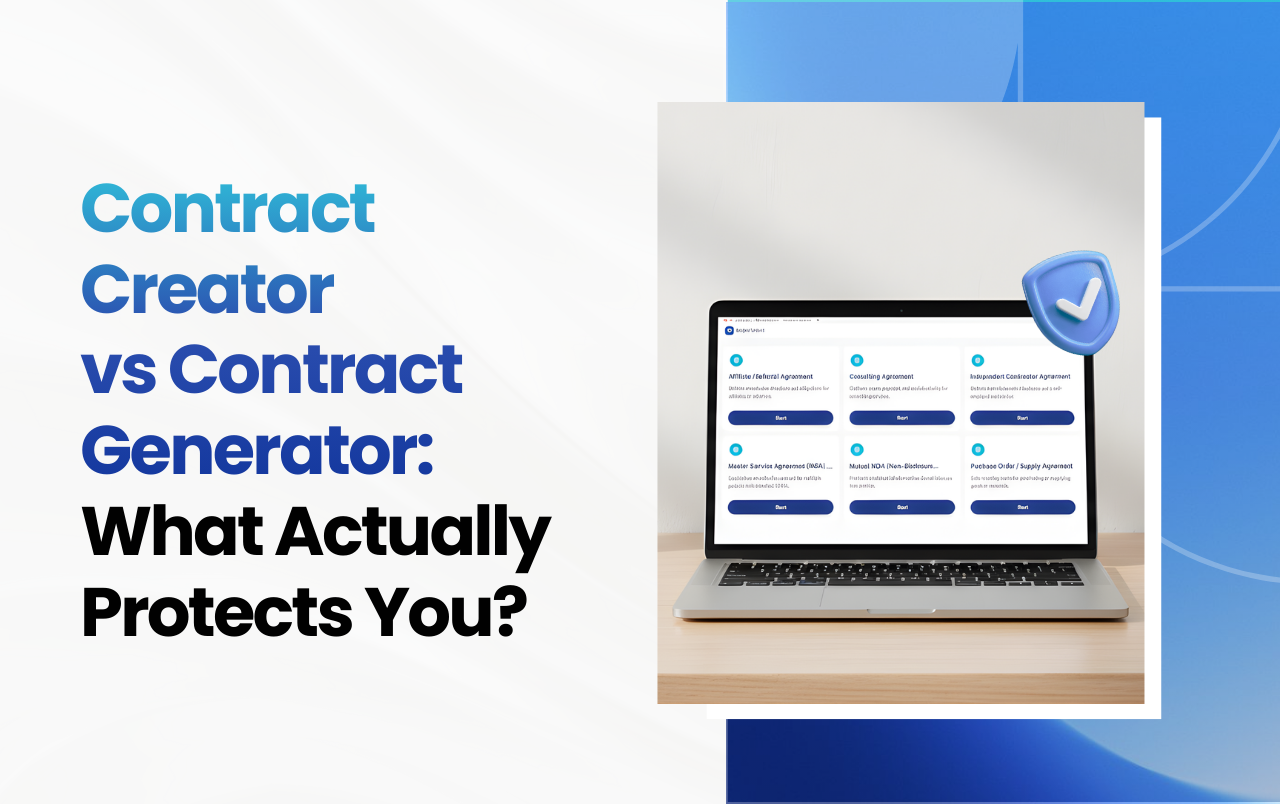
How Does a Contract Creator Differ From a Basic Generator?
It’s simple. A strong contract creator guides you. A basic generator simply fills blanks.
The difference is in the process.
A basic tool:
- Collects minimal inputs
- Produces static output
- Leaves interpretation to you
A guided creator:
- Explains sections in plain language
- Helps you understand each decision
- Shows how choices shape the document
The real problem isn’t generation. It’s a lack of guidance.
Why Do Contract Templates Cause Problems?
Contract templates tend to cause problems because they’re frameworks, not finished agreements.
Contract templates are useful starting points. They provide structure and organization.
Problems arise when:
- Users don’t customize properly
- Vague language remains unchanged
- Sections are copied without review
Templates prevent blank pages.
They don’t prevent misunderstandings.
Are Legal Document Templates Enough on Their Own?
No. They need context and clarity.
Legal document templates often include:
- Standard clauses
- Broad definitions
- General wording
That’s helpful for structure.
Nonetheless, your business, project, or agreement may not be general.
If details are unclear, the document may not function as expected when it matters most.
Do Digital Contract Platforms Solve This Issue?
Not automatically.
A digital contract platform organizes documents and speeds up workflow.
It can:
- Store files
- Manage versions
- Automate formatting
But it does not fix unclear content.
Technology multiplies what you feed into it.
If the base template is weak, the system spreads that weakness.
Why Do Legal Contracts Online Fail Under Pressure?
Legal contracts online collapse under pressure because vague language becomes visible during conflict.
Legal contracts online often work smoothly when everything goes well.
They fail when:
- Payments are delayed
- Scope changes unexpectedly
- Responsibilities are questioned
That’s when people read the fine print closely.
If the document lacks specificity, it cannot guide behavior.
The failure wasn’t sudden. It was built quietly.
Related: Why Most Legal Contracts Online Fail When You Need Them Most
What Are the Signs You’re Using a Basic Generator Wrongly?
Look for hesitation and skipped sections.
Warning signs include:
- You didn’t fully understand a clause
- You rushed through inputs
- You left sections unchanged because they “seemed fine”
- The scope is broadly described
If you felt uncertain during creation, that uncertainty likely remains in the document.
How Can You Reduce Risk When Using a Contract Generator?
Slow down and focus on clarity.
Use this simple checklist:
Before generating
- Define clear scope
- Set specific deadlines
- Clarify payment terms
During creation
- Read each section carefully
- Avoid vague language
- Ask whether the document matches real expectations
After generation
- Review the entire agreement
- Check for inconsistencies
- Confirm responsibilities are clearly assigned
A generator speeds up formatting.
You still control the clarity.
How Does SnapLegal Approach Contract Creation Differently?
By combining structure with explanation.
SnapLegal is a guided, self-serve document creation platform. Instead of presenting static templates, it walks users through each section in plain English.
This approach helps:
- Reduce vague wording
- Prevent skipped clauses
- Improve understanding before download
You don’t just receive a document.
You understand how it was built.
No legal jargon.
No forced sign-up.
You can see the value before committing.
Why Does Clarity Matter More Than Speed?
Speed without clarity tends to create repeated mistakes.
Fast documents are useful.
Clear documents are reliable.
Public guidance consistently highlights the importance of understandable agreements.
The principle is simple: people should understand what they’re agreeing to.
That applies whether the document is created online or offline.
Should You Stop Using a Contract Generator?
No. You should use one that guides you.
A basic generator focuses on output.
A thoughtful platform focuses on understanding.
The real problem isn’t automation.
It’s automation without clarity.
Used properly, these tools save time.
Used carelessly, they scale confusion.
Key Takeaways
- A basic contract generator assumes too much
- Templates need customization and review
- Digital platforms don’t fix unclear content
- Online contracts fail when details are vague
- Clarity during creation prevents future conflict
Final Summary: The Problem Isn’t the Tool. It’s the Assumption.
A contract generator saves time.
It does not replace careful thinking.
The real problem is assuming the document is complete just because it looks complete.
SnapLegal helps you create professional legal documents in minutes through guided, self-serve creation built for freelancers, contractors, and individuals.
No legal jargon.
No appointments.
No sign-up required.
See the value first. Commit later.
Start with SnapLegal today!
Frequently Asked Questions
What is the biggest risk of using a basic contract generator?
Assuming the generated document fully reflects your situation without careful review.
Are contract templates reliable?
Yes, when customized thoughtfully and reviewed carefully.
Does a digital contract platform prevent errors?
It improves organization but does not automatically fix unclear wording.
Why do online legal contracts fail during disputes?
Because vague language becomes visible when expectations clash.
Do I need to sign up to try SnapLegal?
No. You can start creating documents instantly.