
Did a client ever ghost you after weeks of work? Did a business partner “forget” what they agreed to? Did a vendor deliver something completely different from what you discussed? If you answered yes to any of these, what you’re about to read could save you thousands of dollars.
Contract templates for business are not red tape or legal formality — they are your financial shield, your legal backbone, and the foundation every serious business is built on. And the good news? You no longer need to spend $300/hour with an attorney every time you need one.
Quick Answer (Featured Snippet): A business contract template is a pre-drafted legal document that defines the terms, conditions, rights, and obligations between parties in a commercial agreement. It allows small businesses, freelancers, and entrepreneurs to formalize business relationships quickly, affordably, and with full legal validity — without writing every contract from scratch.
According to the U.S. Small Business Administration, more than 60% of commercial disputes among small businesses could have been prevented with a clear written contract from the start. Yet 73% of early-stage startups operate without formal contracts in their first 12 months.
This guide covers everything you need: what contract templates are, which ones your business needs, how to use them correctly, the mistakes to avoid, and how Snaplegal makes the entire process effortless.
What Are Business Contract Templates?
A business contract template is a structured, attorney-drafted legal document you can customize to formalize specific commercial agreements. Think of it as a reusable legal framework that covers all essential legal elements — saving you time, money, and unnecessary risk.
Every valid contract template for business must include:
- Party identification: Full legal names, business entities, and contact details of all involved parties.
- Scope of work / subject matter: A clear, detailed description of the services, products, or agreement involved.
- Payment terms: Amounts, due dates, payment methods, and late payment consequences.
- Timelines and deliverables: Specific deadlines and acceptance criteria.
- Dispute resolution clause: Arbitration, mediation, or applicable jurisdiction.
- Confidentiality clause (where applicable): Protection of sensitive business information.
- Signatures and date: Legally valid in digital or physical format under the U.S. ESIGN Act.
Explore Snaplegal’s full library of business contract templates — all drafted by legal experts and compliant with U.S. commercial law across all 50 states.
Why Contracts Are Non-Negotiable for Your Business
One of the most expensive mistakes entrepreneurs and small business owners make is operating on verbal agreements or informal emails. “We’ve known each other for years.” “It’s my friend.” “I trust them.” These phrases have preceded some of the most devastating business disputes imaginable.
The Real Problem with Verbal Agreements
A verbal agreement is nearly impossible to enforce in a U.S. court. Without written evidence, it becomes your word against theirs. And in the American legal system, without documentation, winning a commercial dispute is difficult, slow, and brutally expensive — regardless of who’s actually right.
According to the American Bar Association, commercial contract disputes between small businesses cost an average of $10,000 to $150,000 in legal fees — independent of the outcome. A well-written contract can prevent you from ever reaching that point.
What a Strong Contract Actually Protects
- Your revenue: Enforces payment with legal backing.
- Your intellectual property: Defines who owns the delivered work.
- Your time: Sets clear boundaries on project scope and additional requests.
- Your reputation: Confidentiality clauses protect sensitive business information.
- Your business: Limits liability for third-party failures or external circumstances.
The 6 Contract Templates Every Business Needs
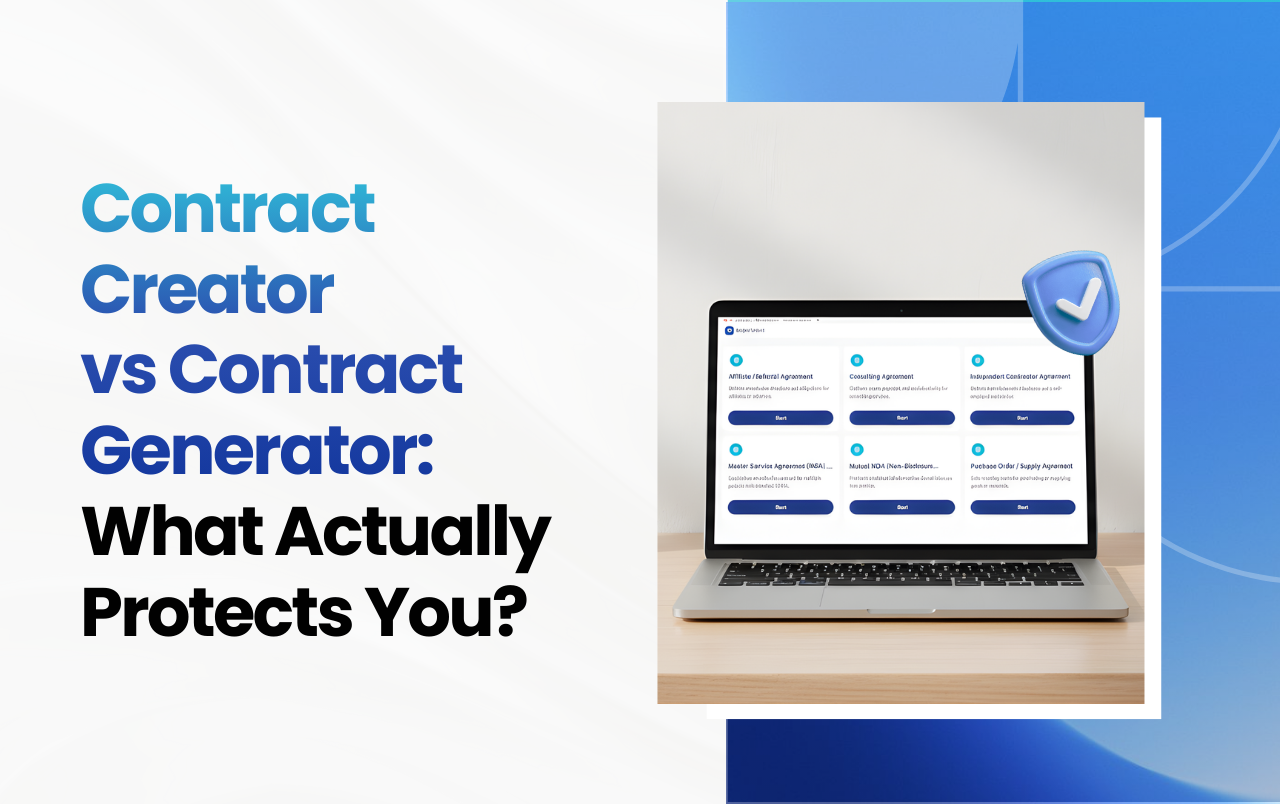
Not all contracts are created equal. The legal protection a solo freelancer needs differs significantly from a VC-backed startup. Here are the essential contracts by business type:
| Contract Type | Who Needs It | What It Protects | Priority |
|---|---|---|---|
| Service Agreement | Freelancers, consultants, agencies | Payments, scope, timelines, deliverables | 🔴 Essential |
| Non-Disclosure Agreement (NDA) | Startups, partners, employees | Proprietary information, trade secrets | 🔴 Essential |
| Independent Contractor Agreement | Businesses hiring freelancers | Employment status, taxes, IP ownership | 🔴 Essential |
| Business Partnership Agreement | Co-founders, business partners | Equity, decision-making, exit terms | 🟡 Important |
| Sales / Purchase Agreement | E-commerce, sellers, distributors | Delivery terms, warranties, returns | 🟡 Important |
| Terms & Conditions | Digital businesses, SaaS, apps | Usage rights, liability, cancellation | 🟢 Recommended |
Access all of these instantly with free contract templates from Snaplegal — no credit card required to get started.
How to Use Contract Templates: Step-by-Step
Downloading a template is just the first step. Here’s how to use it in a way that actually protects you:
- Identify the agreement type: Are you hiring someone, selling a service, forming a partnership? The nature of the relationship determines which template you need.
- Select the right template: Use legal contract templates for business built specifically for your industry or deal type.
- Customize the key fields: Fill in names, dates, payment amounts, scope of service, revision rounds, and any deal-specific clauses.
- Review the critical clauses: Payment, breach, dispute resolution, and intellectual property are the four you must never skip.
- Share with the other party: Give them reasonable time to review and comment. A contract signed under pressure or without understanding can be challenged.
- Sign with legally valid e-signature: Under the U.S. ESIGN Act (2000), electronic signatures carry full legal weight in commercial agreements.
- Archive a signed copy securely: Store contracts in an organized, accessible location. You may need them months or years later.
Pro tip: With Snaplegal, this entire process — from template selection to signed archive — takes under 10 minutes.
Real Case Study: How One Contract Saved $18,000
Background: Marcus, a freelance brand designer in Miami, FL, spent three months on a complete rebrand for a mid-sized company. The deal was verbal: $18,000 total, paid in two installments. When he delivered the final files, the client claimed the work “wasn’t what they envisioned” and refused to pay the remaining $9,000.
The problem: Without a written contract, Marcus couldn’t prove what was agreed, what the acceptance criteria were, or what happened in case of a dispute. His only option was an expensive legal process with an uncertain outcome.
Six months later, Marcus started using Snaplegal. His next client signed a detailed service agreement that included: exact deliverable descriptions, objective acceptance criteria, a 50% upfront payment clause, and a limited revision policy (three rounds only). When that client tried to change the project scope mid-way through, the contract settled it immediately — without a single confrontation.
Key lesson: A well-written contract doesn’t just protect you in disputes — it prevents disputes from happening in the first place, because both parties have crystal-clear expectations from day one.
6 Common Contract Mistakes (And How to Avoid Them)
Having a contract is not the same as being protected. These are the most frequent errors business owners make:
- Using generic internet templates without verifying they comply with your state’s laws or apply to your specific industry.
- Omitting the scope of work clause. Without it, every additional request becomes free work — and clients know it.
- No clear payment terms. Without specific due dates, late fees, and payment method definitions, collecting money becomes a battle.
- Signing without reading. An unfavorable contract you signed in a hurry is still legally binding. Always read before you sign.
- Not updating contracts annually. Your business evolves. Your contracts must evolve with it. Review them every 12 months.
- Skipping the dispute resolution clause. Without it, any conflict goes straight to court — the most expensive and time-consuming option.
Expert Tips for Stronger Contracts
Based on feedback from thousands of small business owners and freelancers using Snaplegal, here are the tips that make the real difference:
- 📌 Define the “what,” not just the “how much.” A contract that describes the service in detail is 10x stronger than one that only mentions the price.
- ⏰ Use specific dates, not approximations. “Delivery approximately in 2 weeks” is unenforceable. “Delivery by June 15, 2025” is not.
- 💰 Require a 30–50% deposit upfront. This filters out non-serious clients and protects you if the project is cancelled.
- 🔒 Add an NDA to any conversation involving sensitive data, even informal ones. Confidentiality protects both the provider and the client.
- ⚖️ Specify the governing law. U.S. commercial contracts should state which state’s law applies (e.g., “Governed by the laws of the State of Florida”).
- 🔄 Limit revision rounds explicitly. “Unlimited revisions” is the #1 cause of scope creep. Define exactly how many rounds of changes are included.
The small business contract templates from Snaplegal already incorporate all of these essential clauses as standard — so you don’t have to think about it from scratch.
Frequently Asked Questions
What are business contract templates and what are they used for?
Business contract templates are pre-drafted legal documents that define the terms and conditions of a commercial agreement. They are used to formalize business relationships, enforce payments, set deadlines, and define responsibilities — without having to write a new contract from scratch every time.
Are free contract templates legally valid in the USA?
Yes, as long as they include the essential elements of a valid contract: offer, acceptance, consideration, and legal capacity of the parties. Snaplegal’s templates are drafted by attorneys and comply with U.S. commercial law, including the ESIGN Act for electronic signatures.
What contracts does a small business need to operate safely?
The essentials are: a service agreement or work contract, a Non-Disclosure Agreement (NDA), an independent contractor agreement, a business partnership agreement (if applicable), and terms and conditions if you offer a digital product or service. These five documents cover 90% of the common legal risks in a small business.
Can I use a contract template without hiring a lawyer?
Yes, for the vast majority of standard commercial agreements. Platforms like Snaplegal offer attorney-drafted templates that anyone can customize without advanced legal knowledge. For high-value contracts (over $100,000), mergers, or complex legal situations, additional review by a specialized attorney is always recommended.
How do I customize a contract template for my specific business?
With Snaplegal it’s simple: select the template for your agreement type, complete the customizable fields (names, dates, amounts, service description, special clauses), preview the final document, and send it for electronic signature — all in under 10 minutes, no legal expertise required.
What is the difference between a service contract and an employment contract?
A service contract or independent contractor agreement applies when you pay someone for a specific piece of work without making them your employee (no benefits, flexible schedule, limited control). An employment contract applies when there is a formal employment relationship with payroll obligations, taxes, and benefits. Confusing these two has serious tax and legal consequences under U.S. law.
Are Snaplegal’s contract templates valid in all 50 U.S. states?
Yes. Snaplegal’s templates are designed to comply with federal commercial law and are adaptable to the specific requirements of each state. You can specify the applicable state within the contract itself to ensure the correct jurisdiction is established.
Conclusion: Contract Templates for Business Are Not Optional
Running a business without contracts is like building a house without a foundation. It might work for a while — but when the first problem hits (and it will), there will be nothing holding you up.
The good news is that contract templates for business are more accessible, faster, and more affordable than ever before. Today, with Snaplegal, you can go from zero legal protection to fully covered in under 10 minutes — with attorney-drafted contracts, e-signature capability, and secure document storage all in one place.
Every day you operate without a contract is a day of unnecessary risk to your business, your income, and your peace of mind. The best time to protect yourself was when you started. The second best time is right now.
→ Start with a free contract template from Snaplegal and protect what you’ve worked hard to build.
→ Explore contract templates for entrepreneurs — built for exactly how you work.
Sources: U.S. Small Business Administration (SBA) · SCORE.org · American Bar Association