Most business disputes don’t start with bad intentions. They start with a misunderstanding — and a missing contract.
Think about the last time a client asked for “just one more revision.” Or a partner assumed they owned the work you created. Or a vendor delivered half of what was promised and expected full payment anyway. These situations feel unfair because they are. But without a written agreement, you have almost no legal ground to stand on.
The solution is simpler than most people think: business contract templates. When used correctly, they don’t just resolve disputes — they prevent them entirely by setting crystal-clear expectations before a single hour of work begins.
Direct Answer: Business contract templates prevent disputes by defining each party’s obligations, payment terms, scope of work, deadlines, and consequences in writing before the work begins. They eliminate the ambiguity that causes most commercial disagreements — protecting your revenue, your time, and your professional relationships.
In this guide, you’ll learn exactly why disputes happen, which contracts you need, how to use them to build a dispute-proof business, and the costly mistakes that leave most small businesses exposed. Let’s get into it.
Why Business Disputes Happen (And Who’s Really at Fault)
Here’s a truth most business advice avoids: the majority of commercial disputes aren’t caused by bad actors. They’re caused by unclear expectations on both sides.
According to SCORE.org, the five most common triggers of small business disputes are:
- Scope creep — The client expected more than what was originally quoted.
- Payment disagreements — No clear due dates, late fees, or milestone-based payment schedule.
- Intellectual property confusion — Both parties believed they owned the final deliverable.
- Cancellation conflicts — No agreed process for ending the engagement early.
- Verbal agreements “misremembered” — Each party recalls a different version of the original deal.
Notice what all five have in common? Every single one is a documentation failure. Not a people failure. Not a trust failure. A contract failure.
And the costs of getting it wrong are staggering. The American Bar Association reports that commercial disputes between small businesses cost an average of $10,000 to $150,000 in legal fees alone — before any judgment is made. Most small businesses simply cannot absorb that kind of loss.
How Business Contract Templates Prevent Disputes
A well-structured contract template for business works as a dispute prevention system. Here’s the mechanism, step by step:
1. They Remove Ambiguity
Disputes thrive in gray areas. A contract eliminates gray areas by converting every verbal assumption into a written, signed commitment. What’s included. What’s not. What happens if it changes.
2. They Set Behavioral Boundaries
When both parties sign a contract that includes a revision policy, a payment schedule, and a termination clause, they behave differently. They know the rules. They follow them. Not because they have to — but because the rules are clear.
3. They Create a Resolution Framework
The best contracts include a dispute resolution clause that spells out what happens if something goes wrong: mediation first, then arbitration, then litigation as a last resort. This alone eliminates the need for court in the vast majority of cases.
4. They Shift Leverage
Without a contract, a non-paying client has all the leverage. With one, you do. A signed agreement that specifies payment terms, late fees, and consequences of breach is an enforcement tool, not just a formality.
7 Clauses Every Dispute-Proof Contract Must Have
Most generic contracts miss at least two or three of these. Every single one matters.
| # | Clause | Why It Matters | Dispute It Prevents |
|---|---|---|---|
| 1 | Scope of Work | Defines exactly what is — and is not — included | Scope creep, extra work claims |
| 2 | Payment Terms | Specifies amounts, due dates, late fees, and methods | Non-payment, partial payment |
| 3 | Revision & Change Order Policy | Limits free revisions and prices additional changes | Unlimited revision demands |
| 4 | Intellectual Property Clause | States who owns the work product after delivery | IP ownership conflicts |
| 5 | Termination Clause | Defines how either party can exit the agreement | Sudden cancellations, mid-project exits |
| 6 | Dispute Resolution Clause | Sets mediation/arbitration as first steps before court | Expensive litigation |
| 7 | Governing Law Clause | States which U.S. state’s law applies to the agreement | Jurisdictional confusion in multi-state deals |
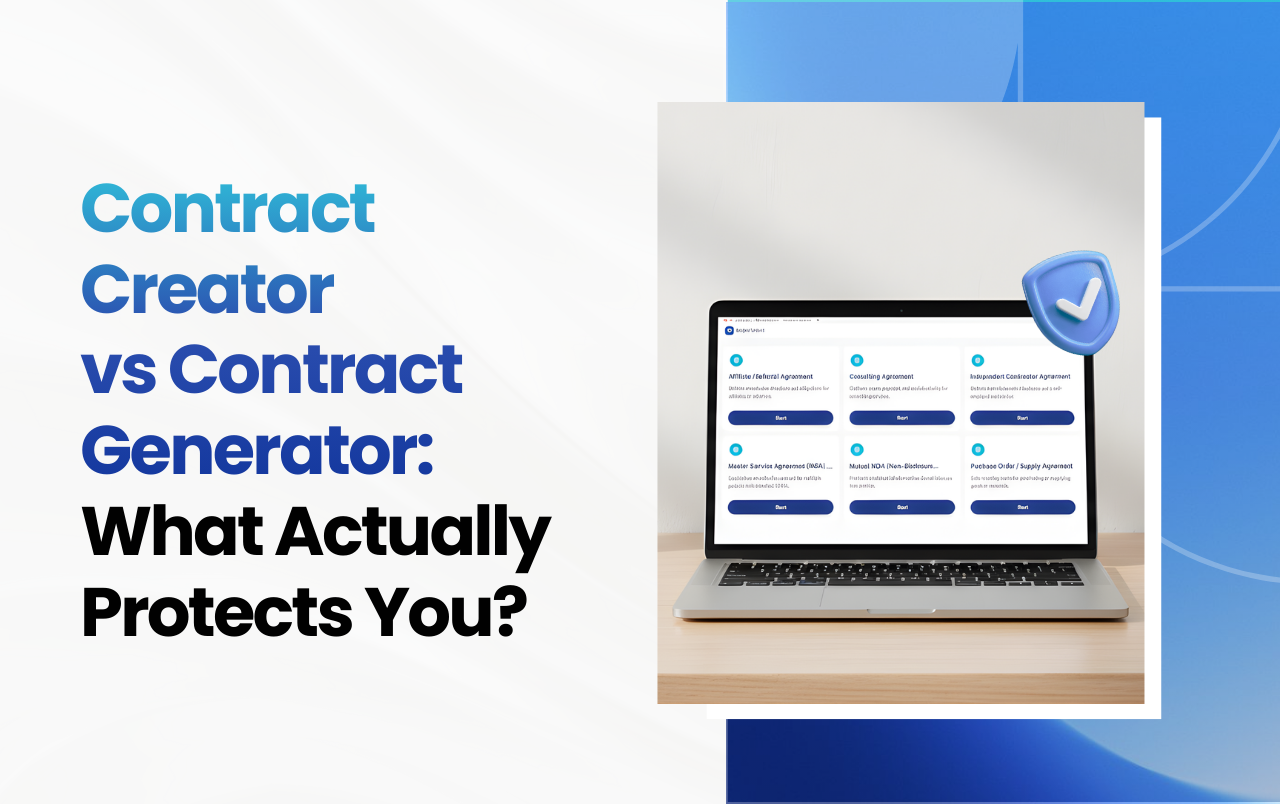
All seven of these clauses are built into Snaplegal’s legal contract templates — properly worded, legally compliant, and customizable in minutes.
The Right Contract for Every Business Situation
Different business relationships require different legal protections. Using the wrong template — or a too-generic one — is almost as dangerous as using no contract at all.
For Freelancers & Independent Contractors
- Service Agreement: Covers scope, payment, revisions, IP, and termination for project-based work.
- Independent Contractor Agreement: Clarifies non-employee status, tax responsibilities, and work ownership.
For Small Business Owners
- Client Services Contract: Formalizes ongoing or retainer-based client relationships.
- Vendor / Supplier Agreement: Protects delivery terms, pricing, quality standards, and liability.
- Non-Disclosure Agreement (NDA): Protects proprietary information shared during negotiations or partnerships.
For Startups & Entrepreneurs
- Co-Founder / Partnership Agreement: Defines equity, roles, decision-making, and exit terms between founders.
- Investment or SAFE Agreement: Outlines terms for early-stage funding rounds.
- Terms & Conditions / Privacy Policy: Required for any digital product, SaaS, or e-commerce store.
Snaplegal’s small business contracts library covers all of these — organized by use case, industry, and business stage, so you always start with the right template.
Real Example: A $22,000 Dispute That a Contract Prevented
The situation: Sarah, a UX/UI designer and solo founder based in Austin, TX, landed a $22,000 website redesign project with a regional retail chain. Excited by the size of the deal, she started immediately — without a signed contract.
Midway through the project, the client began requesting changes outside the original brief: new brand colors, additional pages, a mobile app wireframe. Sarah delivered it all. At completion, the client refused to pay the final $11,000 installment, claiming the “final result didn’t match the original vision.”
The outcome without a contract: No written scope of work. No revision limits. No acceptance criteria. No dispute resolution clause. Sarah’s only option was small claims court (limited to $10,000 in Texas) or a civil suit — both expensive, slow, and emotionally draining.
What changed: After that experience, Sarah switched to Snaplegal. Her next client agreement included an itemized scope of work, a three-revision limit with a $250/hour rate for additional changes, a 50% upfront deposit, and a clear acceptance clause. When the new client questioned a deliverable, Sarah pointed to the signed contract. The conversation ended in two minutes.
The lesson: A contract doesn’t make you suspicious or difficult — it makes you professional. And it filters out the clients who would have caused problems anyway.
Step-by-Step: Build a Dispute-Proof Contract in 10 Minutes
You don’t need a law degree. You don’t need a $500/hour attorney. Here’s exactly how to create a strong, enforceable contract using business agreement templates from Snaplegal:
- Choose the right template type. Match the template to your relationship: service agreement, contractor agreement, NDA, partnership, or vendor contract. Don’t use a generic “catch-all.”
- Define the scope with specifics, not generalizations. Instead of “website design,” write: “5-page website including homepage, about, services, blog, and contact — designed in Figma, developed in WordPress.” Detail is protection.
- Set payment terms that leave zero ambiguity. Include: total amount, deposit percentage, milestone dates, payment method, and a late payment fee (e.g., 1.5% per month after 30 days).
- Add a revision policy with a hard limit. “Includes up to 2 rounds of revisions. Additional revisions billed at $[X]/hour.” Full stop.
- Include acceptance criteria. Define what “done” looks like. What conditions must be met for the client to formally accept the work? This eliminates the “it’s not what I expected” argument.
- Add dispute resolution language. Specify: “Any disputes shall first be submitted to mediation in [State]. If unresolved, binding arbitration under AAA rules shall apply.” This keeps both parties out of court.
- Send for e-signature and archive. A contract signed with a legally valid electronic signature under the ESIGN Act is as enforceable as a wet signature. Store signed copies securely.
5 Contract Mistakes That Invite Disputes
Even businesses that use contracts regularly make these errors — and they’re the ones that end up in disputes anyway.
Mistake #1: Vague Scope of Work
Writing “social media management” instead of “3 posts per week across Instagram and LinkedIn, including copy and graphics, scheduled by Monday noon each week.” Vague language is a litigation invitation.
Mistake #2: No Deposit or Payment Milestones
Waiting until project completion to invoice gives clients full leverage to dispute the final payment. Always require a deposit of 30–50% upfront. For longer projects, tie payments to deliverable milestones.
Mistake #3: Skipping the IP Clause
Who owns the designs, code, copy, or intellectual output once it’s delivered? If the contract is silent, the answer is legally ambiguous — and courts often rule against the service provider. Specify it explicitly.
Mistake #4: Using Old or Unreviewed Templates
A contract from 2018 you found on a forum may not reflect current U.S. commercial law, e-signature standards, or your state’s specific requirements. Always use current, professionally reviewed templates.
Mistake #5: No Termination Clause
What happens if a client stops responding? If you need to exit the project? If either party wants out? Without a termination clause, there’s no defined process — and ambiguity becomes conflict.
Expert Tips From Legal Professionals
These insights come directly from the legal and contract specialists behind Snaplegal’s template library:
- 💡 “The contract conversation is a client filter.” A client who refuses to sign a reasonable contract is showing you who they’ll be when there’s a conflict. Walk away early.
- 💡 “Specificity is your best legal protection.” Every ambiguous word in a contract is a potential argument. If something matters to you, spell it out in plain English.
- 💡 “An NDA should be the first document you sign — not an afterthought.” Any meeting where you share business strategy, pricing models, or proprietary methods should be preceded by a signed NDA.
- 💡 “Add a ‘Change Order’ process to every service agreement.” When clients request changes mid-project, you need a documented process — not just an email thread — to approve, price, and execute changes.
- 💡 “Update your contracts annually.” Tax law, employment classification rules, and digital IP standards evolve. Your contracts should too. Review them every 12 months minimum.
The contract agreements for entrepreneurs at Snaplegal are built with all of these best practices already embedded — so you’re protected from day one, not after the first dispute.
Frequently Asked Questions
How do business contract templates prevent disputes?
Business contract templates prevent disputes by clearly defining each party’s obligations, payment terms, deadlines, scope of work, and what happens if something goes wrong. When expectations are written down and signed, there is no room for misinterpretation — the leading cause of commercial disputes between small businesses.
What should a strong business contract include to avoid disputes?
A strong, dispute-proof business contract must include: a detailed scope of work, specific payment terms with due dates and late fees, a revision or change-order policy, a dispute resolution clause (mediation then arbitration), a termination clause, an IP ownership clause, and signatures from all parties. Missing any one of these creates a vulnerability.
Are business contract templates legally binding in all 50 U.S. states?
Yes. Business contract templates are legally binding across all 50 U.S. states as long as they include the four essential contract elements: offer, acceptance, consideration, and legal capacity. Electronic signatures are equally valid under the federal ESIGN Act (2000). Snaplegal templates are attorney-drafted to meet these standards nationwide.
Can small businesses and freelancers use contract templates without a lawyer?
Yes, for the vast majority of standard business agreements. Attorney-drafted templates from Snaplegal are designed to be used directly by non-lawyers. For complex agreements — equity arrangements, high-value partnerships above $100,000, or multi-jurisdictional contracts — an attorney review adds an extra layer of protection.
What is the most common cause of business disputes between small businesses?
The most common cause is an unclear or missing scope of work — parties simply disagree on what was promised. The second most common is vague payment terms. Both are 100% preventable with a properly structured business contract template that addresses scope, deliverables, payment milestones, and revision limits explicitly.
How quickly can I create a dispute-proof business contract with Snaplegal?
Under 10 minutes. Snaplegal’s templates are pre-structured by legal experts. You select your agreement type, fill in the customizable fields (parties, scope, payments, dates), preview the final document, and send it for legally valid e-signature — all in a single workflow, no legal expertise required.
Conclusion: Stop Disputes Before They Start With Business Contract Templates
The most expensive business dispute is the one you could have prevented with a $0 contract template you simply didn’t use.
Every freelancer who’s chased an unpaid invoice, every small business owner who’s lost a client relationship to a misunderstanding, every entrepreneur who’s watched a partnership fall apart — most of them will tell you the same thing: if only there had been a contract.
Strong business contract templates are not about distrust. They’re about professionalism. They’re about setting clear expectations, protecting what you’ve built, and building business relationships that last — because both parties know exactly where they stand.
With Snaplegal, you can create attorney-drafted, dispute-proof contracts in minutes. No legal background. No expensive consultations. Just clear, enforceable agreements that let you focus on building your business — not defending it.
→ Explore Snaplegal’s Business Contract Templates — Protect your business today.
→ Browse Small Business Contracts — Attorney-drafted and ready to customize.
Sources: U.S. Small Business Administration (SBA) · SCORE.org — Contracts & Dispute Prevention · American Bar Association — Business Law