A contract agreement is a legally binding promise between two or more parties that creates enforceable obligations. In plain English: it’s a written (or sometimes verbal) deal that the law will back up if someone breaks it. Whether you’re a freelancer sending your first invoice, a startup hiring a contractor, or a small business owner partnering with a vendor understanding the basics of a contract agreement is one of the most valuable things you can do to protect yourself.
This contract agreement guide is built for people who are not lawyers but still need legally sound agreements. We’ll walk through everything: what makes a contract valid, the most common types of agreements, what to include, what to avoid, and how tools like Snaplegal make the entire process faster and clearer.
What Is a Contract Agreement?
A contract agreement is a mutual understanding between two or more parties that is intended to be legally enforceable. It establishes who does what, when they do it, how much they’re paid, and what happens if either side doesn’t follow through.
Under U.S. law, a valid contract requires several key ingredients which we’ll break down below. Without those elements, even a signed document may not hold up in court.
Quick definition: A contract is a legally binding agreement between two or more parties that creates mutual obligations enforceable by law. Restatement (Second) of Contracts, American Law Institute
Contracts can be written or verbal. However, written contracts are significantly easier to enforce because they leave no room for “I never agreed to that” arguments. For any business relationship no matter how friendly a written contract is always the smarter choice.
Why Contracts Matter for Small Businesses and Freelancers
Here’s a hard truth: most business disputes don’t happen because someone is dishonest. They happen because expectations weren’t clear from the start.
A client thinks unlimited revisions are included. A contractor assumes payment is due in 30 days. A business partner expects an equal split on profits. Without a binding contract spelling it out, you’re left arguing over memory and intent.
According to the U.S. Small Business Administration, disputes over contracts and payment terms are among the most common legal issues small businesses face. And the cost of resolving one in time, money, and damaged relationships is almost always higher than the cost of writing a clear agreement upfront.
A well-written contract does three critical things:
- Prevents misunderstandings by putting every expectation in writing
- Protects both sides by defining what happens if things go wrong
- Creates legal recourse if one party fails to deliver
If you’ve been relying on handshake deals or email threads to run your business, this guide is going to change how you work.
The 6 Essential Elements of a Legally Binding Contract
Not every document that looks like a contract actually is one. For a contract to be legally binding, it must include these six elements:
| Element | What It Means | Example |
|---|---|---|
| Offer | One party proposes specific terms | “I’ll design your logo for $500.” |
| Acceptance | The other party agrees to those terms | “Yes, agreed. Let’s proceed.” |
| Consideration | Something of value exchanged by both sides | Money for services, goods for goods |
| Mutual Assent | Both parties genuinely agree (no coercion) | Signed voluntarily, no pressure |
| Capacity | Both parties are legally able to enter a contract | Adults, mentally competent, not intoxicated |
| Legality | The contract’s purpose must be lawful | Can’t contract to do something illegal |
Miss any one of these, and a court could rule the contract unenforceable meaning the other party faces zero legal consequences for walking away.
What About Written vs. Verbal Contracts?
Verbal contracts can be enforceable in the U.S. but proving one exists is extremely difficult. Many states also require written contracts for specific transactions: real estate deals, agreements lasting more than one year, and contracts over a certain dollar value all typically fall under the Statute of Frauds, which requires them to be in writing.
Bottom line: always write it down.
Common Types of Business Agreements
Understanding the different types of agreements helps you pick the right one for each situation. Using the wrong contract or a generic one-size-fits-all document can leave important protections out entirely.
1. Independent Contractor Agreement
Used when a business hires a freelancer or contractor for a specific project or ongoing work. It defines the scope of work, payment terms, deadlines, intellectual property ownership, and classification status. This is one of the most essential documents for any freelancer or startup.
2. Non-Disclosure Agreement (NDA)
Protects confidential information shared between two parties. Common before pitching investors, hiring contractors with access to proprietary systems, or entering partnership discussions. NDAs can be mutual (both sides are bound) or one-sided.
3. Service Agreement
A broader contract covering an ongoing or project-based service relationship. Unlike an independent contractor agreement, it often defines service standards, deliverables, timelines, and dispute resolution more formally.
4. Master Service Agreement (MSA)
An umbrella contract that governs the overall relationship between two businesses, with individual projects or services covered by separate Statements of Work (SOWs). Ideal for recurring client relationships.
5. Employment Agreement
Formalizes the terms of a full-time or part-time employment relationship including salary, duties, termination conditions, and non-compete clauses where applicable.
6. Operating Agreement
Governs the internal structure and operations of an LLC or partnership. Defines ownership percentages, decision-making processes, profit distribution, and what happens if a partner exits.
7. Lease Agreement
Covers the rental of property commercial or residential. Defines rent, duration, deposits, maintenance responsibilities, and termination rights.
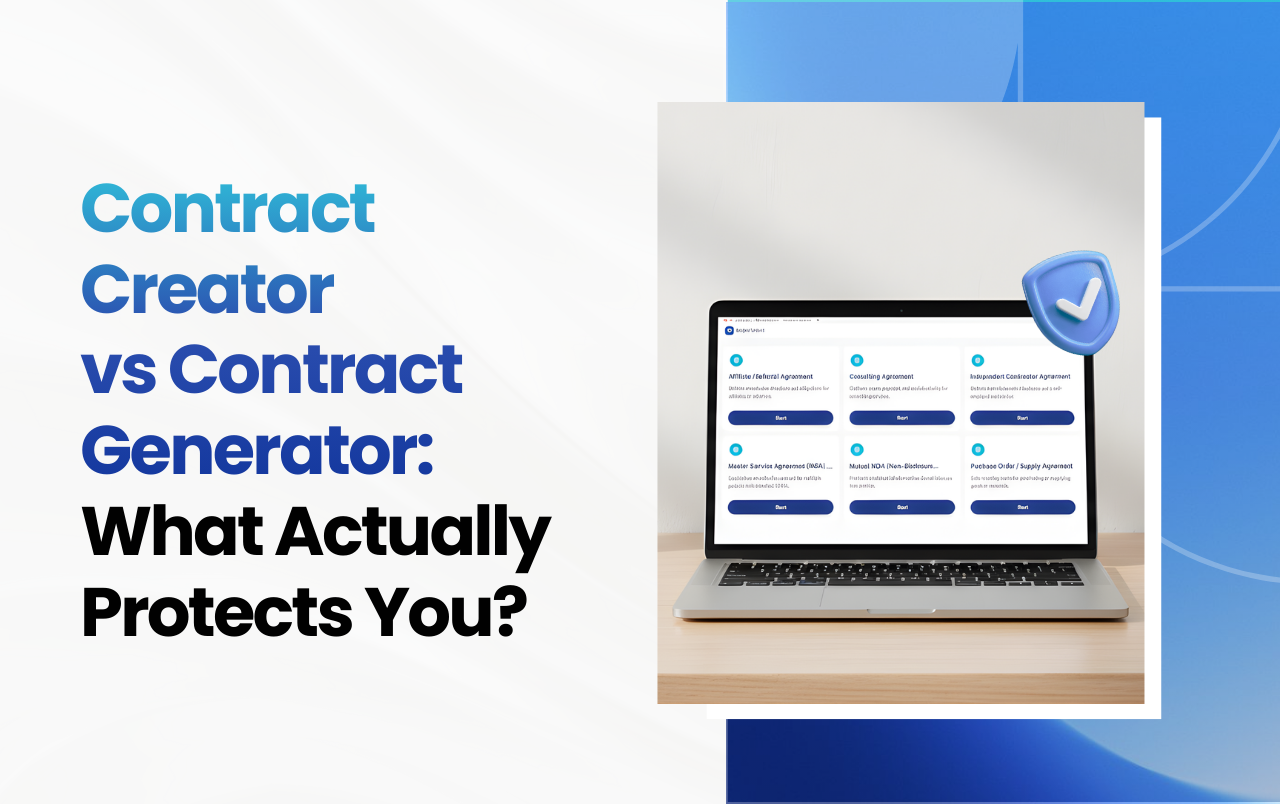
Snaplegal offers ready-to-use, guided templates for all of these. Browse the full template library to find the right one for your situation.
How to Create a Contract Agreement Step by Step
Creating a solid contract doesn’t require a law degree. It requires clarity, completeness, and the right tools. Here’s how to do it:
Step 1: Identify the Parties
Clearly name everyone involved. Use full legal names and, for businesses, include the entity type (e.g., “Acme LLC, a Delaware limited liability company”). Ambiguity here creates problems later.
Step 2: Define the Scope of Work or Obligations
Spell out exactly what each party must do. The more specific, the better. Vague language like “provide marketing services” invites disputes. Better: “Deliver two 800-word blog posts per week, submitted every Monday by 9 AM EST.”
Step 3: Set Payment Terms
Define the amount, payment method, due dates, late fees, and what happens in case of non-payment. Include milestones if payment is tied to deliverables.
Step 4: Include a Timeline
State the start date, end date (or duration), and any key milestones. If a project is ongoing, include terms for how either party can exit the agreement.
Step 5: Add Protective Clauses
These are the sections most people skip and the ones that matter most when things go wrong:
- Confidentiality: Protects sensitive information shared during the engagement
- Intellectual property ownership: Clarifies who owns what is created
- Termination clause: Defines how and when either party can end the agreement
- Limitation of liability: Caps financial exposure for both sides
- Dispute resolution: States whether disputes go to mediation, arbitration, or court
- Governing law: Identifies which state’s laws apply
Step 6: Review, Sign, and Store
Both parties should review the document before signing. Use an e-signature platform to sign digitally this creates an audit trail and is legally valid under the U.S. ESIGN Act and UETA. Store a copy securely and make sure both parties have access. Snaplegal handles all of this in a single workflow.
Want to see how fast this can be? Here’s a full guide on creating a legally binding contract online without a lawyer.
Real-World Example: A Freelancer’s First Contract
Meet Sarah. She’s a freelance graphic designer who just landed her first big client a startup that wants a full brand identity package for $3,500.
They agree over email. The client seems professional. Sarah starts working.
Two weeks in, the client expands the scope: “Can you also redesign our website?” No new contract is signed. Sarah completes the work. The client pays only the original $3,500, claiming the website was “part of the original agreement.”
Without a written contract specifying scope, Sarah has no legal leverage. She can’t prove what was and wasn’t included.
With a proper independent contractor agreement: the original scope is clearly defined, and any additional work triggers a separate written amendment which means Sarah gets paid for every deliverable, every time.
This scenario plays out thousands of times a day. A good contract would have taken 10 minutes to create and saved Sarah thousands of dollars in lost income.
7 Common Contract Mistakes That Can Hurt Your Business
Even people who use contracts regularly make these errors. Avoid them.
- Using a generic template without customizing it Free online templates are a starting point, not a finish line. Always tailor the document to your specific situation. Learn about the real cost of using contract templates incorrectly.
- Leaving scope vague: “Website work” or “marketing support” are not scopes. Be specific about deliverables, formats, quantities, and deadlines.
- Forgetting IP ownership: Especially critical for designers, developers, and writers. Without a clause, there can be genuine legal ambiguity over who owns the final product.
- Skipping the termination clause: What happens if the client disappears? Or the contractor misses every deadline? Define exit terms upfront.
- Not including a payment dispute process: Specify what happens if payment is late: interest charges, pause on work, termination rights.
- Using outdated templates: Laws change. A contract template from five years ago may not reflect current state law, especially for gig worker classification rules. See common contract creator mistakes to avoid.
- Failing to get a signature: An unsigned contract is unenforceable. Always confirm that both parties have signed before any work begins.
Expert Tips for Stronger Agreements
These are the things experienced business operators and legal professionals consistently recommend:
- Write it in plain language. The goal is clarity, not complexity. A contract filled with legal jargon that neither party understands is a contract waiting to fail.
- Always define your terms. If you use the word “deliverable” or “milestone,” define exactly what those mean in the context of your agreement.
- Include a change order process. Scope creep is real. Build in a formal mechanism for requesting and approving additional work and additional payment.
- Date everything. Both the contract itself and each signature should be dated. This matters enormously in disputes over timelines.
- Keep a digital copy in a secure location. Email attachments get lost. Use a contract management system to store, organize, and access your agreements anytime.
- Never start work without a signed agreement. “We can sort out the paperwork later” is how disputes are born. Make signing a condition of starting.
- Use guided contract tools for consistency. Platforms like Snaplegal prompt you through every section, reducing the chance of accidentally leaving out critical clauses.
Frequently Asked Questions About Contract Agreements
What is the difference between a contract and an agreement?
All contracts are agreements, but not all agreements are contracts. An agreement becomes a contract when it includes all six essential elements offer, acceptance, consideration, mutual assent, capacity, and legality and is therefore legally enforceable. A casual agreement to grab coffee is not a contract; a signed service agreement for $5,000 of consulting work is.
Does a contract have to be in writing to be legally binding?
Not always verbal contracts can be legally binding in the U.S. However, many types of contracts (real estate, agreements over one year, contracts over a specific dollar amount) must be written to be enforceable under the Statute of Frauds. In practice, written contracts are always recommended because they provide clear evidence of the agreed terms.
What makes a contract legally binding?
A contract becomes legally binding when it includes all six elements: a clear offer, unambiguous acceptance, consideration (something of value exchanged), mutual assent (genuine agreement without coercion), legal capacity of all parties, and a lawful purpose. Without any one of these, the contract may be voidable or unenforceable.
Can I create a contract without a lawyer?
Yes. For most standard business agreements service contracts, NDAs, independent contractor agreements, and basic leases you do not need a lawyer to create an enforceable contract. Using a guided platform like Snaplegal ensures your document includes all required clauses, uses industry-standard legal language, and is customized to your specific situation. For complex transactions, equity agreements, or high-stakes deals, consulting an attorney is still advisable.
Are electronic signatures legally valid?
Yes. In the United States, electronic signatures are legally valid and enforceable for most contracts under the Electronic Signatures in Global and National Commerce (ESIGN) Act and the Uniform Electronic Transactions Act (UETA). Both laws were established to ensure digital contracts carry the same legal weight as paper ones. Learn more about whether e-signatures are legally binding.
What happens if someone breaks a contract?
A breach of contract occurs when one party fails to fulfill their contractual obligations. Depending on the severity, the non-breaching party may seek remedies including: compensatory damages (money to cover losses), specific performance (forcing the breaching party to fulfill the contract), or contract rescission (canceling the contract entirely). Your contract’s dispute resolution clause determines whether this goes to mediation, arbitration, or litigation.
What is consideration in a contract?
Consideration is the “something of value” exchanged between parties that makes a contract binding. It doesn’t have to be money it can be services, goods, a promise to act, or even a promise not to do something. Without consideration, a contract is essentially a gift promise and is generally not enforceable.
Conclusion: Start Protecting Your Business with a Solid Contract Agreement
A contract agreement isn’t just legal paperwork it’s the foundation of every professional relationship you build. It sets expectations, defines obligations, and gives both parties a clear path forward when things don’t go as planned.
Whether you’re writing your first contract agreement as a freelancer or standardizing legal processes across a growing startup, the principles in this guide remain the same: be specific, be complete, and always get it in writing.
The good news? You don’t need hours with a lawyer to get it right. Snaplegal was built specifically to make contract creation fast, clear, and confidence-inspiring for small business owners, freelancers, and entrepreneurs who’d rather focus on their work than on legal paperwork.
Ready to create your first contract in minutes?
Related Articles You May Find Useful
- Independent Contractor Agreements Explained Without Legal Jargon
- How to Create a Legally Binding Contract Online Without a Lawyer
- E-Signatures Explained: Are Digital Contracts Really Legally Binding?
- How to Choose the Right Contract Template Without Overthinking It
- Why Freelancers Need Better Contracts (and Fewer Awkward Conversations)
Disclaimer: SnapLegal is not a law firm and does not provide legal advice. This article is for informational purposes only. For complex legal matters, consult a licensed attorney in your jurisdiction.