Quick answer: A faster legal workflow for business is a streamlined, mostly digital process for drafting, reviewing, approving, and signing contracts so deals close in hours instead of weeks. The fastest way to get there is to replace manual drafting and email-based signing with automated templates and e-signature, which can cut contract turnaround time by 70–80%.
Every day a contract sits unsigned is a day your revenue sits frozen. For small business owners, startups, and freelancers, a slow contract process isn’t just annoying — it’s the difference between landing a client this week and losing them to a competitor who moved faster.
This guide shows you exactly how to build a faster legal workflow for business, remove the bottlenecks killing your deals, and protect yourself with strong contracts at the same time. No legal degree required.
What Is a Legal Workflow (and Why It Slows Deals Down)
A legal workflow is the step-by-step path a contract takes from “we agreed” to “it’s signed.” It usually includes:
- Drafting the agreement
- Reviewing the terms
- Sending it for approval
- Negotiating edits
- Signing and storing the final version
In theory, this protects everyone. In practice, most small-business workflows are stitched together from Word files, PDF attachments, and long email threads — and that’s where deals go to die. Many legal workflows quietly waste time and increase risk at every handoff.
The real cost of a slow legal process
Slow contracts don’t just delay revenue. They:
- Cool down hot leads — buyer enthusiasm fades fast after the verbal “yes”
- Invite renegotiation — the longer a deal sits, the more terms get reopened
- Create version chaos — nobody’s sure which draft is final
- Damage trust — a clunky signing experience makes you look unprofessional
According to a widely cited industry analysis, inefficient contracting can cost organizations up to 9% of annual revenue. For a business doing $500,000 a year, that’s $45,000 leaking out through pure friction.
The Hidden Bottlenecks Blocking Your Deals
The legal bottleneck in business deals is rarely the contract itself. It’s the process around it. Here are the four most common chokepoints — and most businesses have all four.
| Bottleneck | What It Looks Like | Time Lost |
|---|---|---|
| Manual drafting | Copy-pasting from an old contract, editing by hand | 2–6 hours per deal |
| Email ping-pong | “See attached v3_final_FINAL.docx” | 3–10 days |
| Print-sign-scan | Chasing physical or scanned signatures | 2–7 days |
| No central storage | Searching inboxes to find the signed copy | Ongoing |
These delays compound. A deal that should take an afternoon stretches across two weeks. The friction multiplies when you’re dealing with complex legal documents full of dense clauses nobody wants to read twice.
First-hand example: A freelance brand designer I worked with was losing roughly one in five clients between the proposal and the signed contract. The reason wasn’t price — it was that her contract arrived as a PDF the client had to print, sign, scan, and email back. Switching to a guided template plus one-click e-signature dropped her close time from 9 days to under 24 hours, and her lost-deal rate dropped to nearly zero.
Root Cause Analysis: Why Workflows Break
Before you fix the symptoms, understand the disease. Slow legal workflows almost always trace back to three root causes:
1. The process is manual by default. Every contract is treated as a one-off creative writing project instead of a repeatable task. Manual contract handling reliably creates more problems than it solves — version errors, missed clauses, and lost files.
2. Signing lives in the physical world. Print, sign, scan, and email is a relic. Each step adds a day and a chance for the deal to stall.
3. There’s no single source of truth. When contracts live in inboxes and desktops, nobody knows the current status. “Did they sign yet?” becomes a daily question.
Fix these three and the speed takes care of itself.
How to Build a Faster Legal Workflow for Business (Step by Step)
Here’s the exact framework to streamline your contract signing process and close deals quicker. You can implement most of this in an afternoon.
Step 1: Standardize your core contracts
Identify the 3–5 agreements you use most — service agreements, NDAs, proposals, statements of work — and turn each into a reusable template. Stop writing from scratch.
- Lock in your protective clauses (payment terms, scope, liability, termination)
- Leave only the deal-specific fields blank (names, dates, amounts)
- Have each template reviewed once, then reuse it forever
Step 2: Automate the drafting
Replace copy-paste with automated generation. A good digital legal workflow tool asks you a few questions and assembles a complete, consistent document in minutes — no missing clauses, no formatting drift.
Step 3: Switch to e-signature
This is the single biggest speed win. Closing deals faster with e-sign isn’t incremental — it’s transformational. When you automate contract creation and signing, a client can review and sign from their phone in under five minutes.
In the U.S., electronic signatures are legally binding under the ESIGN Act (2000) and the Uniform Electronic Transactions Act (UETA), so an e-signed contract holds up exactly like ink on paper.
Step 4: Centralize storage and tracking
Keep every contract in one searchable place with clear status (draft / sent / signed). You’ll always know where a deal stands without digging through email.
Step 5: Measure your turnaround time
You can’t improve what you don’t track. Measure the time from “draft created” to “fully signed.” Driving contract turnaround time improvement is exactly the kind of operational discipline that also helps you prevent business disputes with better contracts — clear, consistent documents leave less room for argument later.
Before vs. After: What Speed Actually Looks Like
| Stage | Old Manual Workflow | Faster Digital Workflow |
|---|---|---|
| Draft contract | 2–4 hours | 5–10 minutes |
| Send for review | Email attachment | Instant secure link |
| Get signature | 3–7 days | Minutes to hours |
| Store & find later | Hunt through inbox | One searchable hub |
| Total time to close | 1–2 weeks | Same day |
Common Mistakes That Keep Deals Slow
Even businesses that “go digital” sabotage themselves. Avoid these:
- Over-customizing every contract. Reinventing the wheel on each deal kills your speed. Standardize first, customize only the essentials.
- Sending contracts as flat PDFs. If the client has to print and scan, you’ve already lost days. Use e-signature.
- No follow-up system. Sent contracts get forgotten. Use automated reminders.
- Skipping the protective clauses to “move fast.” Speed without protection is a trap. Fast and safe is the goal — never trade one for the other.
- Keeping legal review as a bottleneck. Pre-approve your templates once instead of routing every deal for fresh review.
Expert Tips to Move Even Faster
- Send the contract within an hour of the verbal yes. Enthusiasm is highest right after agreement. Strike while it’s hot.
- Pre-fill everything you can. The fewer blanks the client faces, the faster they sign.
- Mobile-optimize the signing experience. Most people will sign from a phone — make sure they can.
- Use plain-language summaries. A short “here’s what this means” note above dense clauses dramatically speeds up trust and signing.
- Batch your template reviews quarterly. Update all templates at once instead of mid-deal.
Frequently Asked Questions
What is the fastest way to speed up my legal workflow?
The fastest single improvement is switching from manual drafting and print-sign-scan to automated templates plus e-signature. This combination typically cuts contract turnaround time from days to hours and removes the most common legal bottleneck in business deals.
Are e-signatures legally binding for business contracts in the USA?
Yes. Electronic signatures are legally valid and enforceable in the United States under the ESIGN Act (2000) and UETA. An e-signed contract carries the same legal weight as a handwritten one for nearly all business agreements.
How much time can a digital legal workflow tool actually save?
Most small businesses cut contract creation from hours to minutes and reduce signing time from days to hours. Overall, a faster legal workflow for business commonly delivers a 70–80% reduction in total turnaround time.
Will moving faster make my contracts less safe?
No — if done right, it makes them safer. Standardized, pre-reviewed templates apply your protective clauses consistently to every deal, reducing the human errors that cause disputes. Speed and protection reinforce each other.
Do I need a lawyer to streamline my contract signing process?
Not for the workflow itself. You can standardize templates, automate drafting, and add e-signature without a lawyer. It’s wise to have a lawyer review your core templates once; after that, you reuse them freely.
What’s the first thing I should do this week?
Pick your single most-used contract, turn it into a clean reusable template, and set it up for e-signature. That one change alone will visibly shorten your next deal.
Close Your Next Deal in Hours, Not Weeks
A faster legal workflow for business isn’t a luxury reserved for big legal teams — it’s the simplest competitive edge available to any small business owner, startup, or freelancer. Standardize your contracts, automate the drafting, switch to e-signature, and track your turnaround. Do that, and the deals you’re currently losing to slow paperwork start closing the same day.
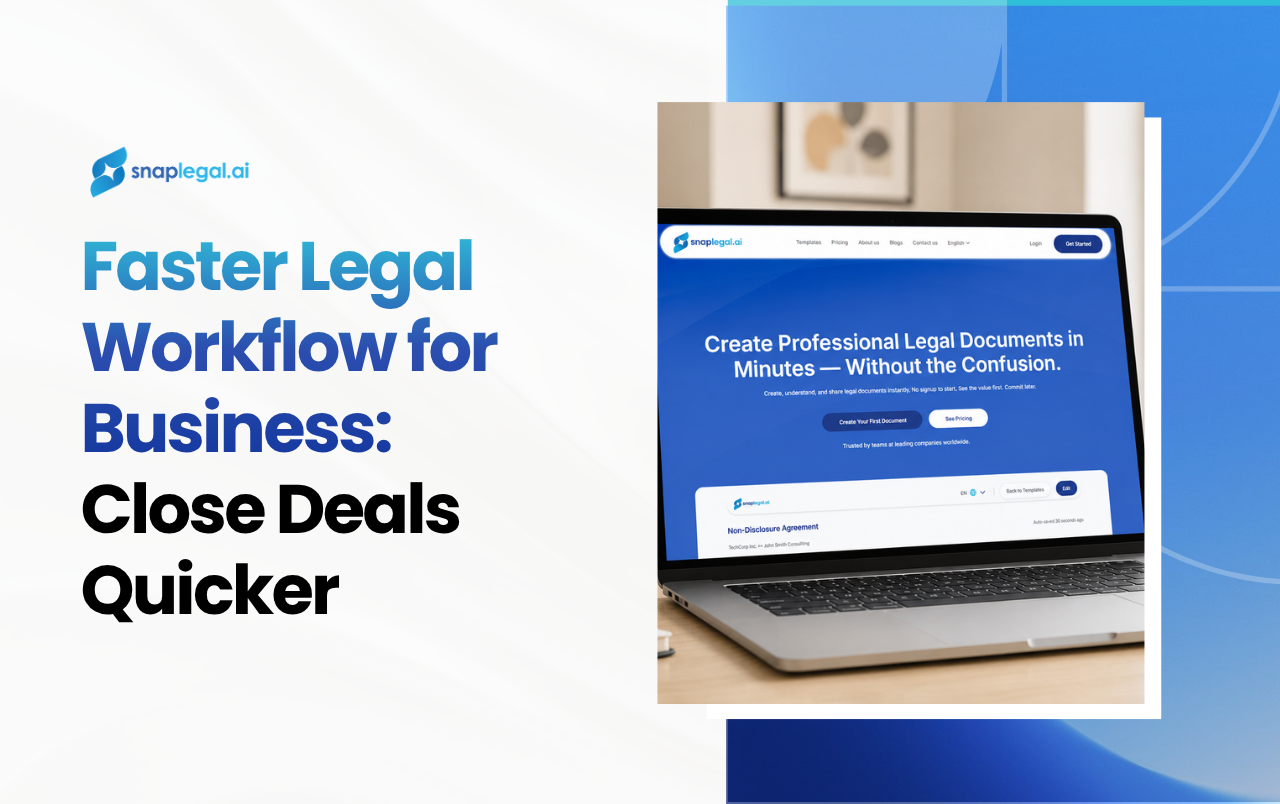
Snaplegal brings all of these pieces together in one place — guided contract creation, built-in protective clauses, and fast e-signing — so you can close deals quicker without sacrificing the protection your business depends on.
👉 Ready to stop losing deals to slow paperwork? Try Snaplegal today and send your next contract in minutes.